No-Code Websites and Apps · Launch Your Product
Improving Performance
Improve products with real data
Improve Performance
Your product is now live. But "live" doesn't mean "done." Some users might sign up and never come back. Others might start the checkout and abandon it.
In this final lesson, you'll learn to read what your users are telling you through their behavior and make the changes that improve results. Let's finish strong!

What "Performance" Actually Means
Performance indicates whether the product achieves its goal. Every product has a small set of numbers that tell you if it's working. Those are your metrics.
For different products, you will track different metrics.
- For BrightMinds: are parents subscribing, are kids completing lessons, and are families staying month after month?
- For FitBase: are members booking classes, showing up, and renewing?

Pick the Right Metrics
The most common mistake is tracking everything. Page views, button clicks, scroll depth — most of it is noise. What you need are actionable metrics: numbers that, if they change, tell you exactly what to fix. Each product has different ones.
practice preview
Interactive practice
Fill in the blank
Ask ChatGPT to identify the most important metrics for each product.
Set Up Tracking
You can't improve what you can't measure. Lovable already includes its own analytics. You can use Google Analytics if you want extra tracking and are adding the Google tag to the project yourself.
Google Analytics is a free tool that tracks how users behave on your website or app: which pages they visit, where they drop off, and what actions they take. Let's add it to your product.
Create a Google Analytics property for your website and open your web data stream to find the measurement ID (the code that starts with G-).
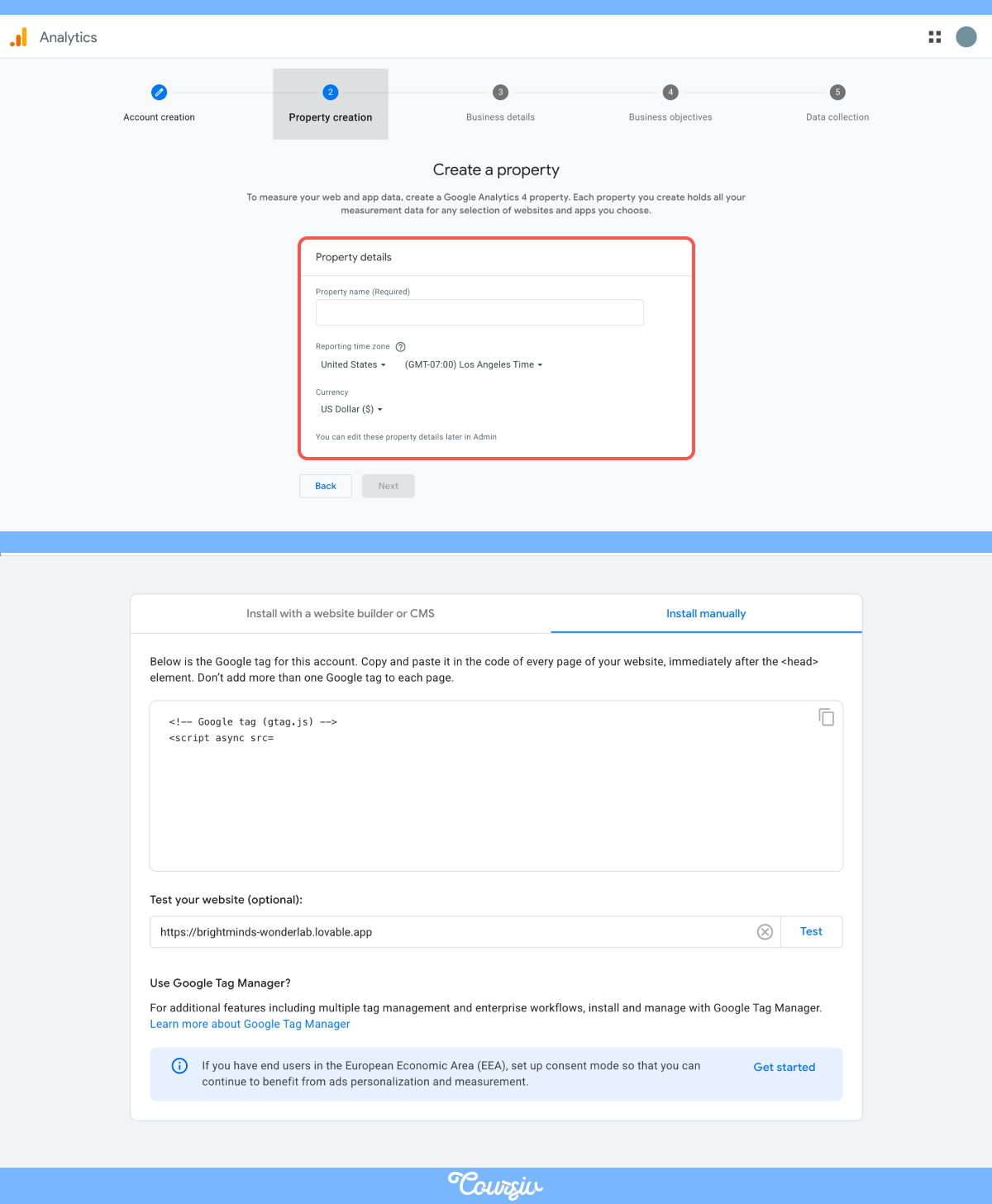
To connect Analytics to your site, you either enter that ID into a builder that supports Google Analytics directly or add the full Google tag code to your site. Once the tag is installed, Google Analytics can start collecting visitor data.
In Bolt.new, you can add Google Analytics by inserting the Google tag code into your site — either manually in Code view or by asking Bolt.new in the chat to add it for you.
Find the Bottleneck
Metrics tell you the product is underperforming. Bottleneck analysis tells you where. A bottleneck is the single point in your user flow where the most people drop off. Fix that one point, and everything downstream improves.

Let's Look at FitBase
The FitBase studio owner tells you, "People book classes but don't show up. My no-show rate is around 30%." This is a retention problem. And it costs the studio real money because every empty spot could have gone to another member.
practice preview
Interactive practice
Fill in the blank
Ask ChatGPT to analyze the no-show problem and suggest solutions.
practice preview
Interactive practice
Fill in the blank
Prompt Bolt.new to implement the top fix for FitBase.
Select all that apply
Which of these are signs that a product change is working?
Build an Iteration Roadmap
You've fixed a bottleneck in your product. But improvement is a cycle. Measure → Identify → Fix → Measure again.
The question is: what do you fix next? You need a simple roadmap that prioritizes changes by impact.
practice preview
Interactive practice
Fill in the blank
Ask ChatGPT to build a 30-day improvement roadmap for FitBase.
The Iteration Mindset
Products that stay the same after launch slowly die. Products need to iterate based on real data to get better every week.
You don't need to rebuild everything at once. Measure, find the weak point, and make one targeted change at a time.
practice preview
Interactive practice
Put in order
Arrange the steps for improving any live product.
- Track actionable metrics, not everything: Focus on numbers that tell you exactly what to fix, like no-show rates — not general stats like page views.
- Find the bottleneck first: The single biggest drop-off point in your flow is where improvement has the most impact.
- Use AI to analyze problems and suggest fixes: Upload your data into ChatGPT to identify causes and prioritize solutions.
- Improvement is a loop, not a one-time event: Measure, identify, fix, measure again — products that stop iterating stop growing.
What You've Built
Over 7 lessons, you went from a blank page to two live, revenue-generating digital products. You built a website and an app with AI tools, added AI features and automations, launched to the public, and now you know how to improve what you've built based on real data.

What's Next Is Yours
The tools and skills you've practiced — prompting AI builders, designing user flows, setting up payments, analyzing funnels — work for any product, any client, any idea. BrightMinds and FitBase were your first two. And now you can build the next one!