AI for SEO · Building and Scaling SEO With AI
SEO Measurement & Iteration
Track SEO performance and act on the data
Measure, Learn, and Improve Your SEO
For your home decor business, you need to know which of your 10 published articles are actually driving traffic, and where people are dropping off.
In this lesson, you'll know how to track SEO performance, identify patterns using AI tools, and systematically improve results based on real data.

What Is SEO Measurement?
SEO measurement means tracking the signals that show whether your SEO efforts are paying off.
Common signals include organic traffic, clicks from search results, how users engage with pages, and whether they take actions such as making purchases or submitting inquiries.
Iteration is what you do after measurement.
Measurement shows what's happening. Iteration uses that data to make improvements — fixing underperforming pages and scaling what works. SEO grows through this continuous cycle, not through one-time changes.
Choose one
How do measurement and iteration benefit your business in practice?
What to Measure: Focus on Traffic
Many SEO metrics exist, but this lesson focuses on the foundation: organic traffic.
Traffic shows whether people can find and reach your site through search. Rising traffic indicates healthy visibility; declining traffic signals a problem worth investigating.
To track organic traffic, we'll use Semrush, a tool you've already seen for backlink and keyword analysis. Semrush also estimates organic traffic, top pages, and trends over time — even for sites you don't own.
We're going to use IKEA as an example to learn what to look for.
Step 1: Analyze Organic Traffic in Semrush
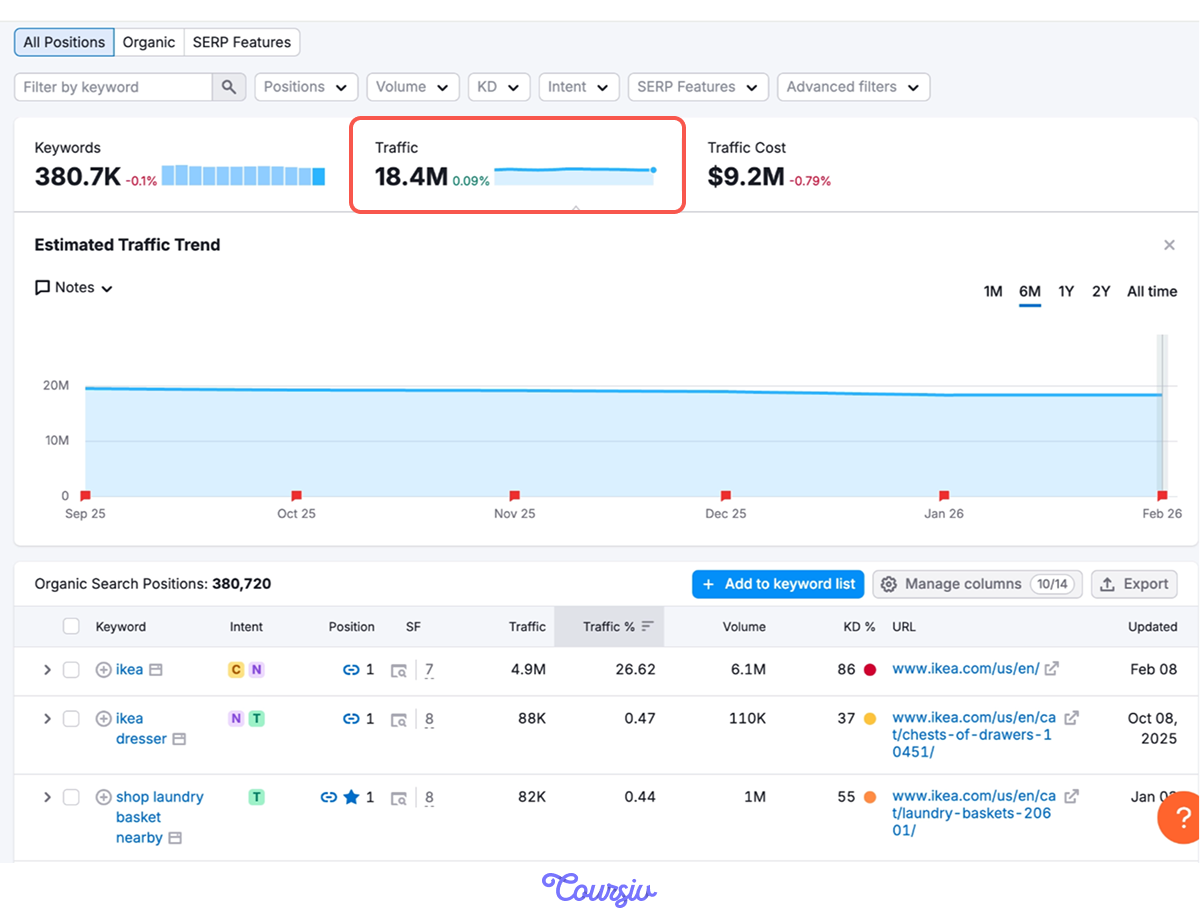
Go to Semrush and enter a domain. Once you enter IKEA's website, click on Organic Rankings, and you'll see Traffic, Traffic Cost, and Keywords.
Let's examine the Traffic metric on Mobile across six months.
This is what strong SEO looks like in practice. IKEA's 18.4M monthly organic visits show what we've been building toward — the right keywords, strong visibility, and consistent content.
Now that we can see IKEA's traffic data, the next step is understanding why it works — and what your business can take from it.
For this, we're using DeepSeek. It breaks down what's driving it and translates it into a concrete strategy you can apply to your own business.
practice preview
Interactive practice
Fill in the blank
Use DeepSeek to analyze what drives IKEA's traffic success and apply it to your business.
Excellent!
IKEA's traffic strategy combines brand searches, product-specific keywords, and local intent.
For your business, aim to grow all three over time — brand recognition, purchase-intent keywords, and local visibility — instead of relying on only one type.
Understanding IKEA's strategy shows you what to aim for. But what if your current traffic is declining instead of growing? This is where iteration comes in: taking what measurement reveals and using it to make specific improvements.

How to Iterate with AI
That's iteration — taking what your data shows and turning it into targeted improvements. When traffic drops, investigate first: look at which pages lost traffic and why.
A rankings drop means your content may need updating. A low CTR means your title or meta description isn't compelling. A high bounce rate means users aren't finding what they expected.
Once you know the cause, you fix it. Let's say your analysis found that your top pages lost 20-30% of traffic over 6 months — here's how to decide what to fix first and what to change.
practice preview
Interactive practice
Fill in the blank
Use DeepSeek to prioritize which pages to update based on traffic data.
Great Work!
DeepSeek prioritized updates by impact: pages with the highest previous traffic and steepest drops get fixed first — they have the most to regain. Pages with high past traffic and sharp declines offer the biggest recovery opportunities. This prevents wasted effort on low-impact pages.
Now you understand each step: how to measure traffic in Semrush, analyze patterns with DeepSeek, prioritize fixes, and make specific improvements.
Next, let's connect these steps into one repeatable system.
practice preview
Interactive practice
Put in order
Put these steps in the correct order to show how measurement and iteration work together.
Perfect!
This cycle keeps SEO focused and efficient.
You measure first, act second, and confirm results before scaling — avoiding random or premature changes.
- Track organic traffic in Semrush over six months — trends matter more than single snapshots.
- Use DeepSeek to learn from traffic patterns — apply IKEA's keyword mix (brand, product, local intent) to your own strategy.
- When traffic drops, find the cause first — rankings, CTR, or bounce rate each need a different fix.
- Prioritize pages with the highest traffic and steepest decline — update titles, content, and freshness signals.
Almost There!
You've completed nine lessons covering every aspect of SEO: strategy, research, planning, optimization, technical fixes, authority, user experience, local visibility, and now measurement.
In the final lesson, you'll connect everything into one complete SEO system — a repeatable process that grows with your business using AI tools strategically. See you there!