AI for SEO · Building and Scaling SEO With AI
AI-Assisted Content Planning
Plan smarter, more focused content with AI
Build Driving Content Plans
You have your keyword clusters from Lesson 2 — but keywords alone won't get you results. Most people jump straight to writing and waste weeks on content that Google never shows.
Let's build a proper plan before you write a single word.

What Is Content Planning?
Content planning means analyzing what's already ranking, identifying what topics Google expects you to cover, and structuring your content to match search intent before you write.
Choose one
Why does planning content before writing improve your business results?
The Three Planning Questions
Before writing any content, you need to answer three critical questions. Each reveals what Google expects and what your content must deliver to rank.

- Question 1: What topics must you cover?
- Question 2: How should you structure it?
- Question 3: What depth does a search engine expect?
Let's answer these questions one by one using AI tools.
What Topics Must You Cover?
In the previous lesson, AnswerThePublic showed you what questions people ask. Now you need to know how to answer them.
For that, we'll use Frase — an AI-powered tool that analyzes top-ranking pages and tells you which topics you need to cover. It also tracks your visibility across Google, ChatGPT, and Perplexity, which matters more than ever as people increasingly turn to AI tools for answers.
We'll start with Frase's SERP Research feature — this shows you what topics Google already rewards for your target keyword, so you're building your content on proven ground.
What Is SERP?
SERP — the list of results search engines shows when someone searches. By analyzing the SERP, you see what Google already rewards for your keyword — the exact topics top-ranking content covers. Let's try researching!
Step 1: Start Your Research
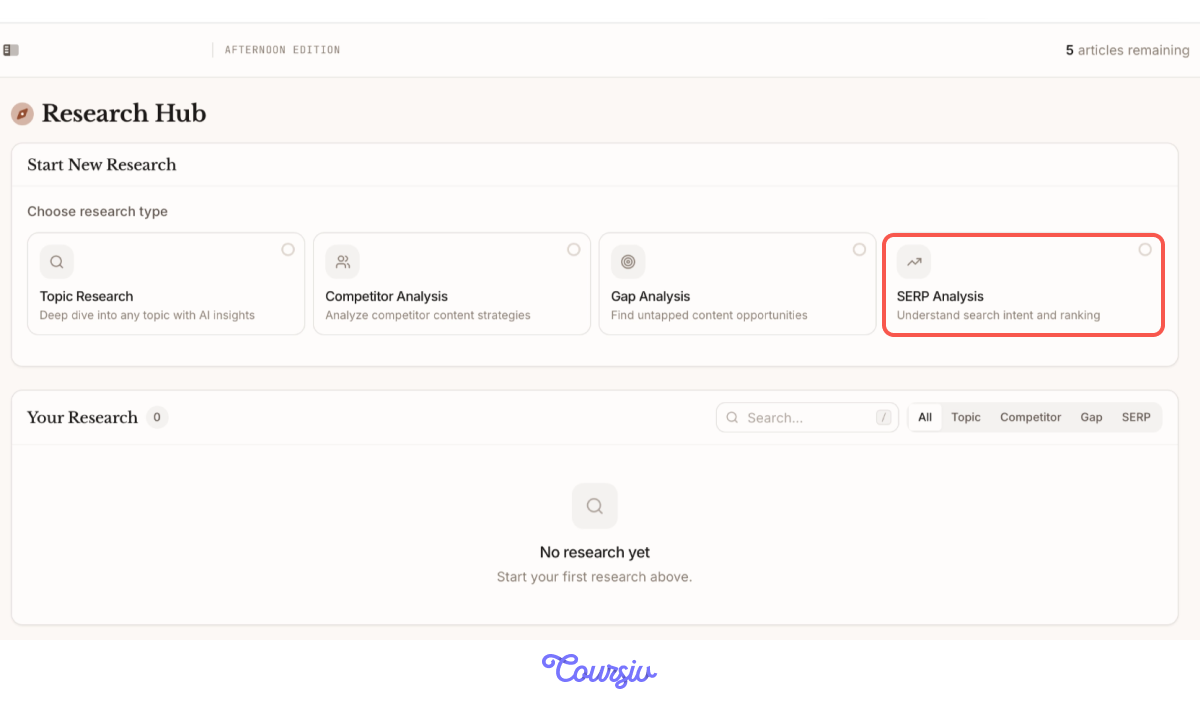
Go to Frase and pick SERP Research. Then enter your target keyword from your cluster, such as "minimalist bedroom ideas" from Lesson 2. Click on the keyword to begin your analysis.
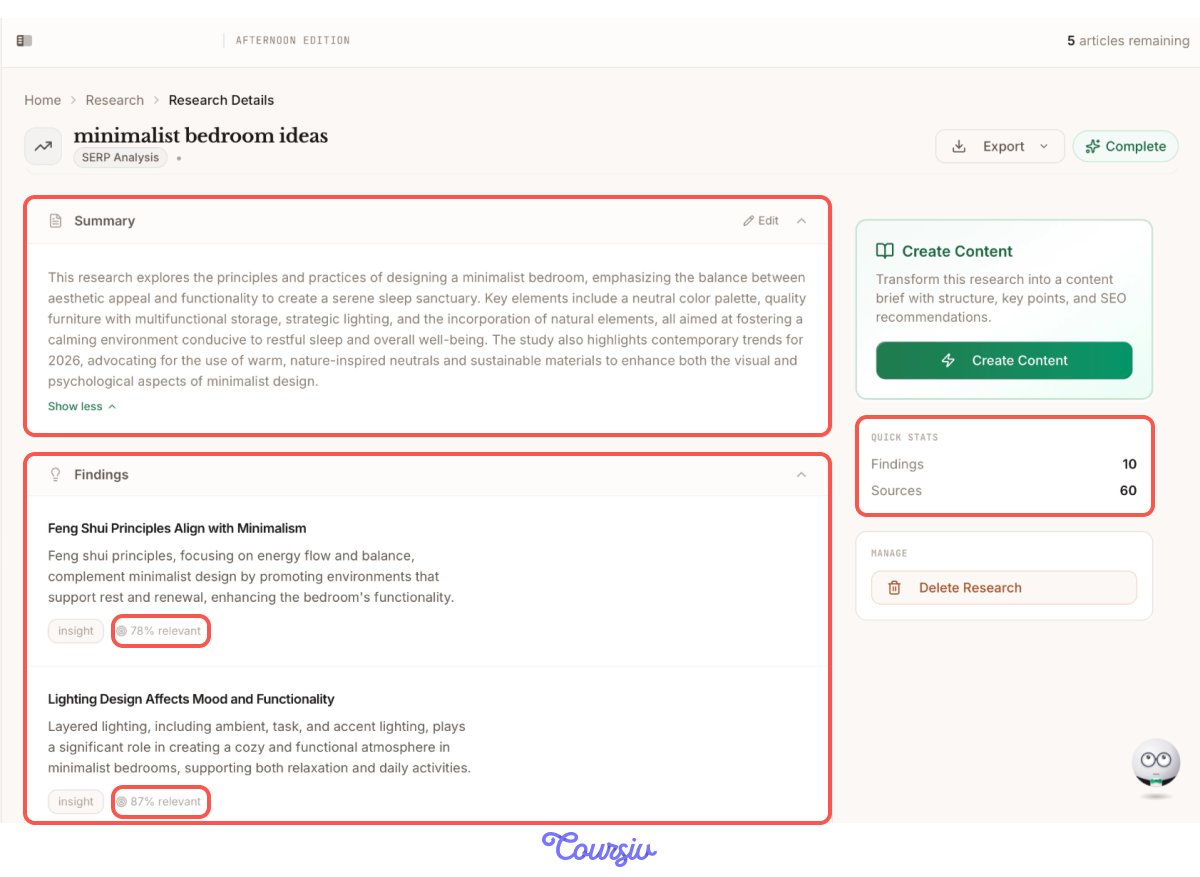
Once Frase completes the analysis, it displays the Summary, Findings, and Sources. You'll see the relevance percentage next to each topic.
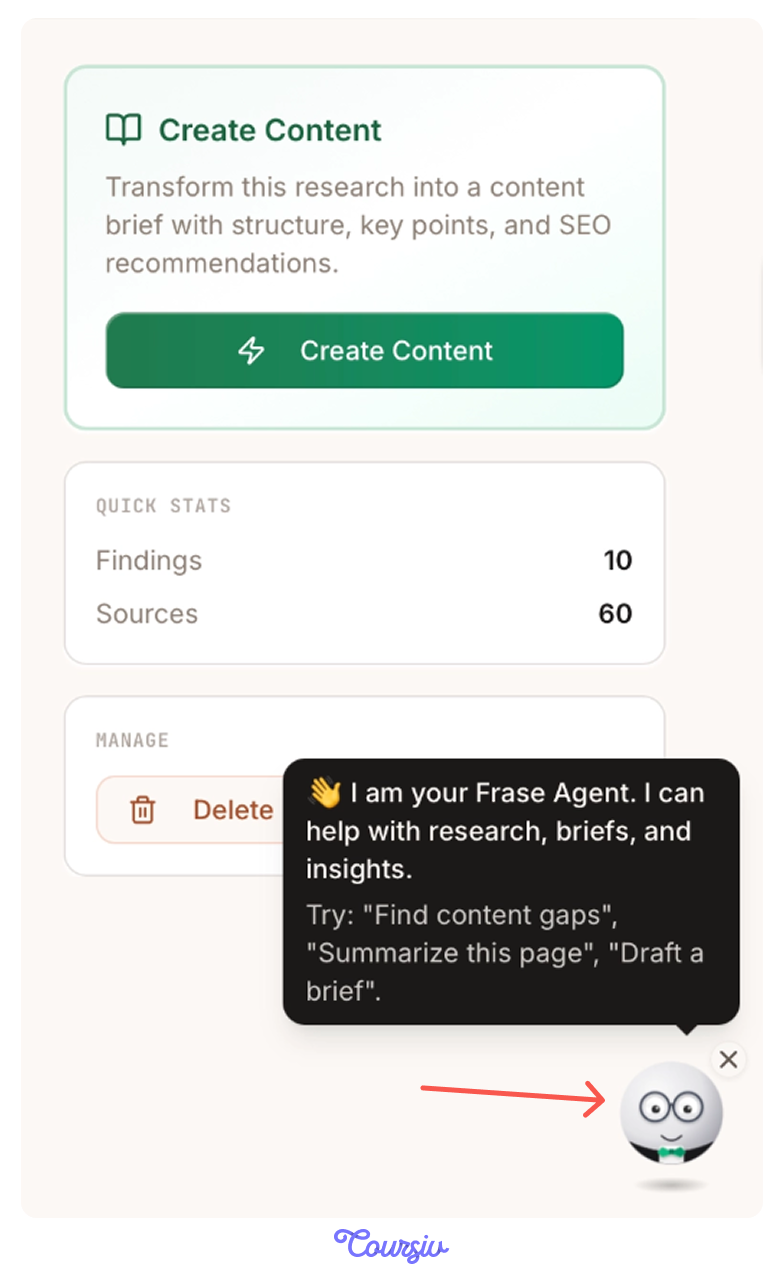
You just pulled data from top-ranking pages. Next, ask Frase Agent to analyze it and identify which topics matter most based on how frequently they appear across high-ranking content.
practice preview
Interactive practice
Fill in the blank
Ask Frase Agent to break down topics by how frequently they appear in search results.
Perfect!
You just answered Question 1 — you know what topics to cover based on what's already ranking.
Question 2 is next: How should you structure this content to match what a search engine expects?
How Should You Structure Content?
Listing topics randomly won't rank — you need to organize them in a logical structure that matches how top-ranking pages present information.
This creates a strong, effective content plan. Frase data shows you which topics appear, but ChatGPT helps you organize them into a clear, scannable outline with proper hierarchy and flow that readers and Google both understand.
Structuring Text Within Topics
Good text structure helps people find answers quickly. This means:
- Start with a direct answer: Answer the question immediately, not after background.
- Use question-based logical blocks: Each answers one specific question.
- Write short paragraphs: 2-4 lines max, people scan, not read.
- Include lists and bullet points: Google and users prefer structured information.
- Add FAQ when relevant: Covers additional questions, boosts relevance.
Let's ask ChatGPT to structure the "neutral colors" topic from your outline using these principles.
practice preview
Interactive practice
Fill in the blank
Use ChatGPT to structure the "neutral colors" topic.
Great Work!
You structured one topic ("neutral colors") in detail with direct answers, question-based headings, short sections, and relevant FAQ.
But there's a final question: How deep should you go in each idea within the topic? This determines whether your content is comprehensive enough to compete. That's Question 3 — content depth.
What Depth Does Google Expect?
Content depthin SEO refers to how completely a page satisfies search intent — from minimal mentions to fully covering core and related questions with context and examples.

Why does depth matter? Remember from the first lesson that Google ranks based on three factors: Relevance, Authority, and Experience.
Depth directly impacts relevance. If your article mentions "neutral colors" in one sentence while competitors explain color theory, show five palette examples, and link to products, they satisfy the search intent more fully — they'll outrank you.
Select all that apply
Which key factors determine how much depth your content needs for a specific topic?
practice preview
Interactive practice
True / False
Evaluate this content approach based on depth and relevance.
Yes! Depth is about matching the comprehensiveness competitors use to satisfy search intent.
Back in Frase, check average word counts for top results. If they average 2000 words total, aim for 1800-2200 words. If your "neutral colors" section appears in competitors at 400 words, write 350-450 words with similar depth: color psychology, examples, and actionable guidance.
Great Work!
You just answered all three planning questions! You know what topics to cover, how to structure them, and how deep to go in each idea.
You have all the pieces. Now let's pull them together into one complete, revised content plan ready for writing.
practice preview
Interactive practice
Fill in the blank
Use ChatGPT to combine everything into one executable plan on the topic, including structure and depth.
You just created a complete content blueprint based on what's already ranking. You know what topics to cover, how to organize them, and how deep to go — all from Frase SERP analysis and ChatGPT planning.
No words are written yet, but this plan gives you a clear, data-driven path to create content that resonates and performs.
practice preview
Interactive practice
Put in order
Put these content planning steps in the correct order to create a complete, data-driven content plan.
- Keep the three planning questions in mind: What topics to cover? How to structure it? What depth does Google expect?
- Use Frase to analyze top-ranking pages and identify must-cover topics (appear in most results), and should-cover topics (appear frequently). Focus on what must be covered first.
- Structure for scannability: direct answer at the start of each section, 2-4 line paragraphs, bullet points, and FAQ.
- Use ChatGPT to combine Frase topics, question-based structure, and depth targets into one complete content blueprint — before writing a single word.
You know how to turn keyword clusters into complete content plans using Frase and ChatGPT.
In the next lesson, you'll learn how to write and optimize this content for maximum impact!