AI Performance Marketing · Advanced Optimization and Strategic Growth
Sustainable Performance Marketing
Building sustainable performance systems
Your Final Challenge
You've mastered campaign setup, optimization, channel expansion, measurement, and fraud prevention. This is your final challenge: "How do we turn using AI tools across campaigns and platforms into a system that runs without constant firefighting?”
Today, you'll integrate channels, automation, and measurement into one cohesive system, define optimization cadences that prevent chaos, and build a roadmap for sustainable growth that doesn't require reinventing everything quarterly. Let's complete your performance marketing journey!

Tactics Without Systems
Most marketers accumulate tactics — a Google Search campaign here, a Meta experiment there, email automation somewhere else. Each works independently, and nothing connects.
A performance marketing system means channels inform each other, measurement feeds optimization decisions automatically, and you know exactly when to act and when to wait.
TechFlow runs several campaigns but lacks a system. Without frameworks, every decision feels urgent and reactive.
Let's discover what happens when you ask AI for help without system context.

practice preview
Interactive practice
Fill in the blank
Ask Claude to organize TechFlow's marketing activities.
Choose one
What's missing from this organizational approach?
Understanding Integration Requirements
Channel-by-channel advice doesn't create a system. You'd get separate recommendations for each platform, but no coordination between them.
Integration requirements define how channels work together: when to shift budget between them, how to use data from one channel to improve another, and what triggers automatic decisions. Now let's define another critical piece: optimization cadences.
Optimization Cadences
You've seen why integration matters. But there's another critical piece: when to make decisions for each channel.
Optimization cadence means knowing when to make decisions, not just what to decide. Daily changes to low-volume campaigns read noise as signal. Monthly reviews of high-volume campaigns miss opportunities.

For example, TechFlow's Google Search generates many conversions per week — enough data for weekly optimization decisions. But Email generates fewer conversions per week — weekly changes would overreact to randomness. You need sufficient conversions before patterns emerge.
Let's ask Claude to design the right review frequency for each of TechFlow's channels based on their conversion volume.
practice preview
Interactive practice
Fill in the blank
Ask Claude to set review frequencies for each channel.
Perfect!
You've designed cadences that match data velocity: frequent reviews for high-volume channels, less frequent for a low-volume channel.
This prevents overreacting to noise while catching real opportunities. Now let's integrate everything into a single system.
practice preview
Interactive practice
Fill in the blank
Ask Claude to design a cross-channel coordination system.
Now you have a system: budget rules that shift based on performance, shared measurement across channels, decision triggers that coordinate actions, and cadences matched to data velocity.
This is what separates high-performing teams from reactive ones — systems that coordinate channels automatically based on predefined rules.
Assigning AI Tools to System Functions
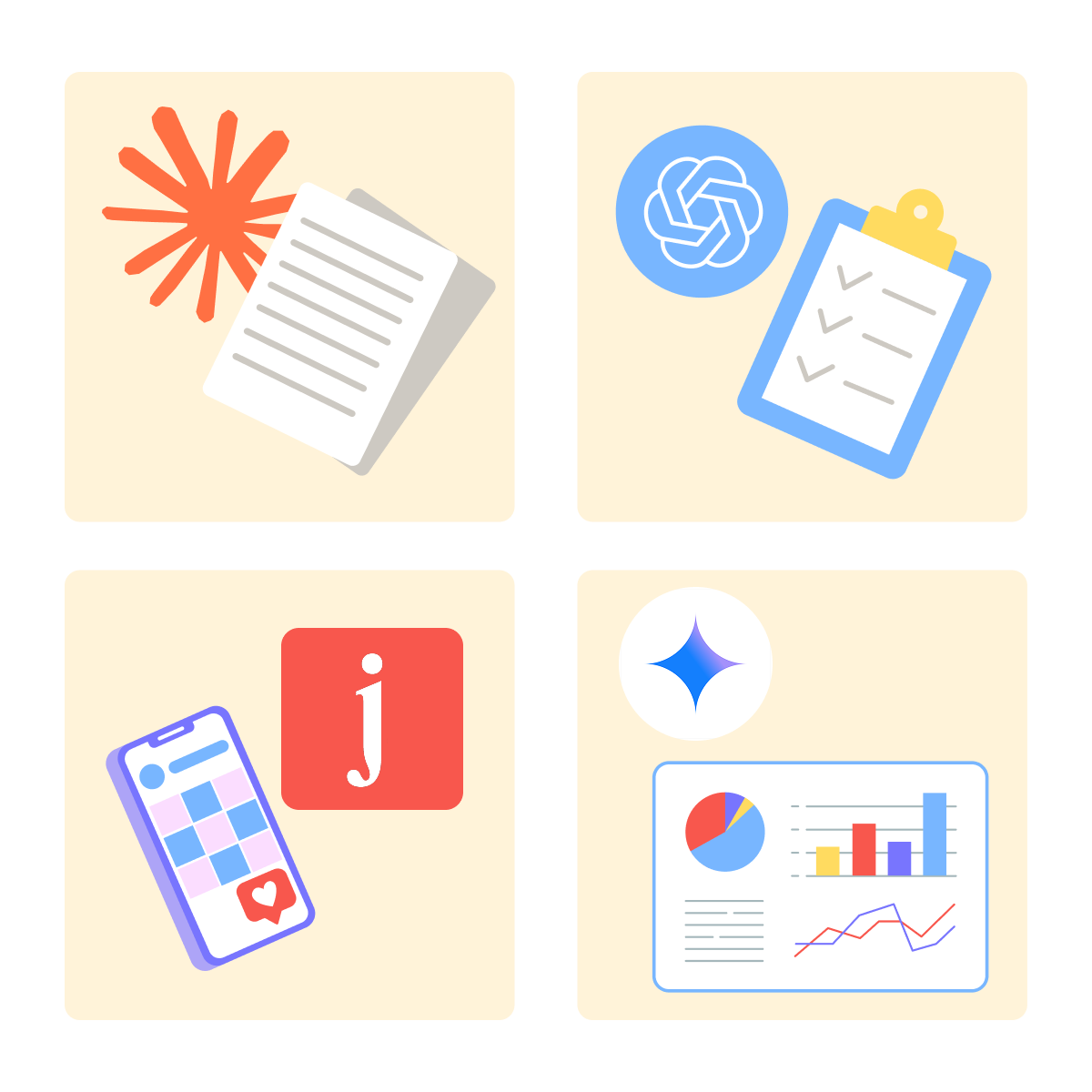
Different AI tools serve different system functions.
- Claude handles strategic reasoning and design.
- ChatGPT handles structured workflows and documentation.
- Jasper handles creative production at scale.
- Gemini validates measurement and platform alignment.
- DeepSeek analyzes performance patterns.
Most marketers use tools randomly, but systems assign tools to specific functions.
Choose one
TechFlow needs to produce 24 Meta Creative concepts (3 per campaign × 8 campaigns) with consistent brand voice, platform-specific formats, and A/B test variations. Which tool do you think handles this best?
You've matched tool to function: Jasper scales creative production while maintaining brand consistency — letting TechFlow's team produce content that would normally require a larger creative department.
This is how AI tools amplify performance marketers: you focus on strategy, AI handles execution at scale. Now let's look at the platform tools we've covered throughout the guide.
AI tools generate strategy and creative, but platform tools execute and measure:
- Performance Max — campaign delivery
- Looker Studio — visualization
- Mailchimp — email automation
- Canva AI — visual assets
practice preview
Interactive practice
Match pairs
Tap a left item, then a right item to match.
Choose one
Why does TechFlow need both AI tools and platform tools instead of just one category?
Perfect!
You've built a complete tool stack: AI tools for strategy and creative (Claude, ChatGPT, Jasper, Gemini, DeepSeek) + platform tools for execution and measurement (Performance Max, Looker Studio, Mailchimp, Canva AI).
This is how modern performance marketing operates — AI accelerates thinking and content creation; platforms deliver campaigns and capture data. Now let's build your long-term roadmap.

Building Your Long-Term Roadmap
A performance marketing roadmap defines what you'll test, when you'll scale, and how you'll know you're succeeding over the next quarters. Without roadmaps, marketing becomes reactive.
TechFlow's roadmap should specify quarterly priorities, experiments, scaling decisions, and efficiency improvements. Let's design it with AI.
practice preview
Interactive practice
Fill in the blank
Ask Claude to build a quarterly performance marketing roadmap.
Excellent!
You've built a roadmap that sequences priorities logically: stabilize baseline (Q1), test new channels (Q2), scale winners (Q3), optimize efficiency (Q4). Each quarter builds on the previous one instead of starting from scratch.
This is how sustainable growth happens — systematic experimentation within strategic frameworks.
Headline: Course Complete: Your Performance Marketing System
Across this course, you've built a complete AI-powered performance marketing foundation:
Unit 1: Campaign setup (Google Search, Meta) with keyword strategy, and targeting layers
Unit 2: Optimization loops with continuous monitoring, diagnostic thinking, and budget reallocation
Unit 3: Channel expansion across email, social media, and display — with audience-behavior matching, platform-native creative, and social media strategy covering organic content, paid amplification, and community engagement
Unit 4: Advanced measurement with valid testing, attribution models, incrementality, fraud detection, and system integration
You now operate as an AI-powered performance marketer with systems, measurement rigor, and strategic frameworks to drive real growth.
Excellent work! You've completed a journey most marketers never take — moving from tactical campaign execution to strategic, AI-amplified performance marketing built on systematic frameworks and measurement rigor.
You've answered every critical question throughout these lessons. Which channels drive growth? How do I scale without waste? How do I prevent fraud?
You're now a confident performance marketer with the complete toolkit — AI strategy tools and execution platforms. Whatever you choose to do next with your performance marketing skills: growing TechFlow, launching your own venture, or managing campaigns for other businesses, you now have a complete system to follow.
Congratulations on mastering performance marketing with AI!