AI Performance Marketing · Search and Contextual Advertising
Search Intent & Keywords
Understanding search intent and keywords
From Copy to Clicks: Understanding Search Intent
Welcome back to TechFlow! Your campaigns are running, and you're tracking metrics. But today your CEO asked, "Why are we paying $15 per click for some keywords and $2 for others?"
Today, you'll answer that question by discovering how search intent determines keyword value and cost, why contextual advertising is resurging in a privacy-first world, and how to build keyword strategies that balance reach with efficiency using AI tools.

Why Contextual Advertising Is Back
For years, performance marketing relied on tracking individual users across the web through cookies, pixels, and browsing history. We've touched upon the iOS 14.5 update before.
The update changed everything by requiring apps to obtain users' permission to track users. Most said no (only 4-20% agreed), which is killing retargeting lists, ad accuracy, and sales tracking for a large share of phone users, alongside GDPR rules and vanishing cookies.
Contextual advertising stepped in as the alternative. Instead of tracking user browsing history ("this person visited competitor sites last week"), it targets based on content relevance ("this person is reading an article about marketing automation right now").
TechFlow delivers ads on pages about "workflow automation" or "marketing efficiency," capturing real-time intent through content signals — no cookies, pixels, or IDFA tracking needed, fully iOS 14.5-compliant.
This shift makes keyword strategy and understanding of search intent more critical than ever.
Select all that apply
Why is contextual advertising valuable in a privacy-first environment?
Now that you understand why contextual advertising matters, let's discover how search intent determines which keywords are actually worth bidding on for TechFlow.

Keywords
Not all keywords are created equal. Some attract researchers, others attract buyers.
- Low-intent keywords are educational (e.g., "what is marketing automation" or "SEO basics for beginners"). People are just exploring.
- High-intent keywords are transactional (e.g., "marketing automation software comparison" or "book SEO audit"). People are ready to buy, sign up, or hire. Target high-intent keywords when you want traffic that converts, not just traffic that reads.
Understanding intent also means recognizing exactly what the searcher wants. Google groups search intent into three specific categories, each requiring a different approach.
Search intent falls into four categories:
- Informational — learning
- Navigational — finding a specific site
- Commercial — researching options
- Transactional — ready to buy
TechFlow should bid differently on each type.

But how do you analyze hundreds or thousands of keywords by intent? Doing this manually would take weeks.
This is where AI becomes essential for keyword analysis. Let's compare a vague AI request with a structured one.
practice preview
Interactive practice
Fill in the blank
Ask DeepSeek to analyze keywords without a clear intent framework.
Choose one
Do you think this classification is useful for TechFlow's bidding strategy?
See the problem? Generic classifications don't help TechFlow make bidding decisions. Instead, let's get structured intent analysis with clear strategic recommendations.

practice preview
Interactive practice
Fill in the blank
Ask Gemini to classify keywords with the intent framework and bidding strategy.
Choose one
Why is this structured approach better for TechFlow?
Excellent!
A more structured approach helps you understand which keywords to prioritize and bid on, but how can you deepen your understanding of what to target?
Look at your competitors. Analyzing their keyword strategies reveals gaps in your own approach — high-value terms you're missing, audience segments you haven't considered, and intent signals you've overlooked. Let's use AI to analyze competitor keywords at scale and uncover opportunities TechFlow is leaving on the table.
Competitive Keyword Analysis
TechFlow's competitors are running ads on hundreds of different keywords. Manually analyzing which ones actually drive conversions would take days of tedious research.
AI can handle this at scale — processing competitor keyword lists in minutes, identifying gaps in your strategy, and surfacing high-value opportunities you're missing.
practice preview
Interactive practice
Fill in the blank
Ask DeepSeek to analyze competitor keyword strategy and find gaps.
Great Work!
You've discovered that TechFlow is missing high-value transactional keywords such as "workflow automation platform" and has an intent gap.
These insights reveal which keywords matter, but not how to organize them into a working strategy. You need a structure that tells you how much budget each keyword type receives, which bidding approach to use, and what success looks like for each.
TechFlow's Keyword Strategy
You've learned intent classification and competitive analysis. Let's structure TechFlow's complete keyword strategy across three tiers:
- Core: High-intent transactional keywords
- Expansion: Mid-funnel navigational keywords
- Awareness: Top-of-funnel informational keywords
Each tier has a different budget allocation, bidding strategy, and set of success metrics.
practice preview
Interactive practice
Fill in the blank
Ask DeepSeek to create a tiered keyword strategy with budget allocation.
Monitoring Keyword Performance
Your keyword strategy is live. But intent shifts, competition changes, and search behavior evolves. You need systematic monitoring to catch these changes.
Semrush shows which keywords drive conversions, where you're losing impression share, and where competitors are outbidding you.
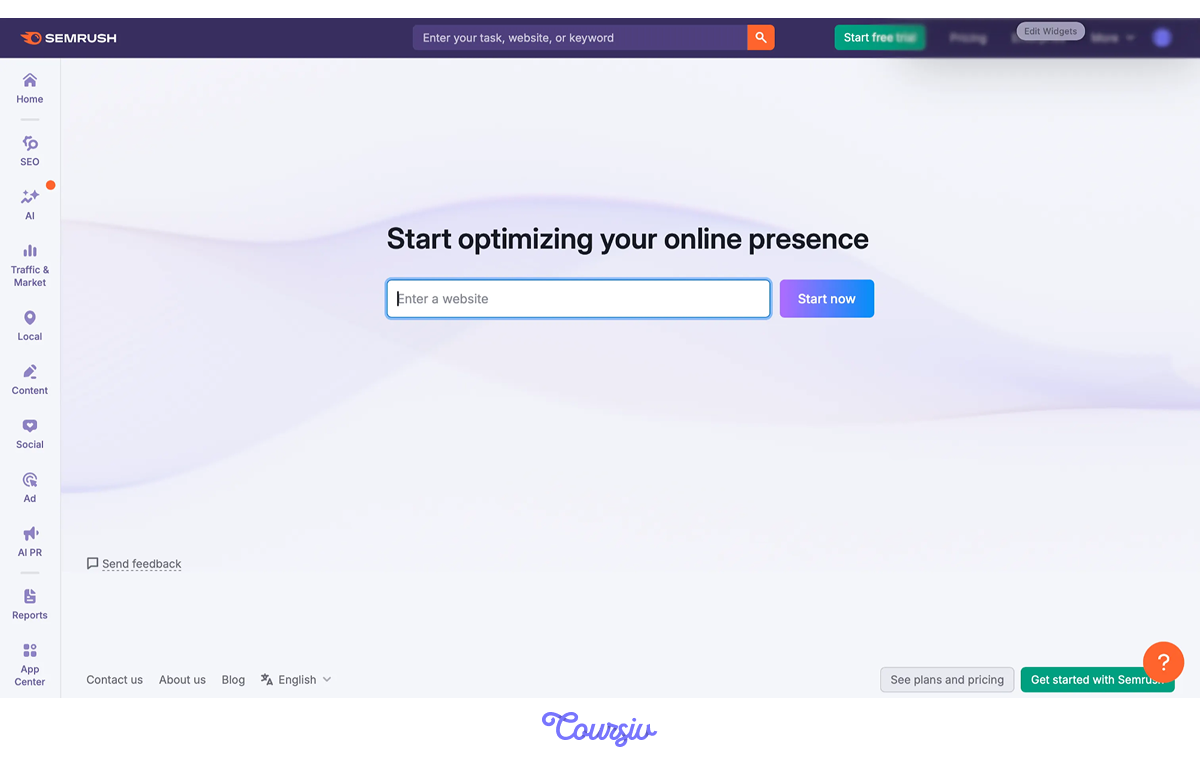
Meet Semrush
Semrush is an all-in-one keyword research and competitive intelligence platform that tracks your keyword performance in real-time. This is how it looks.
Now let's look at how to set up keyword monitoring for TechFlow.
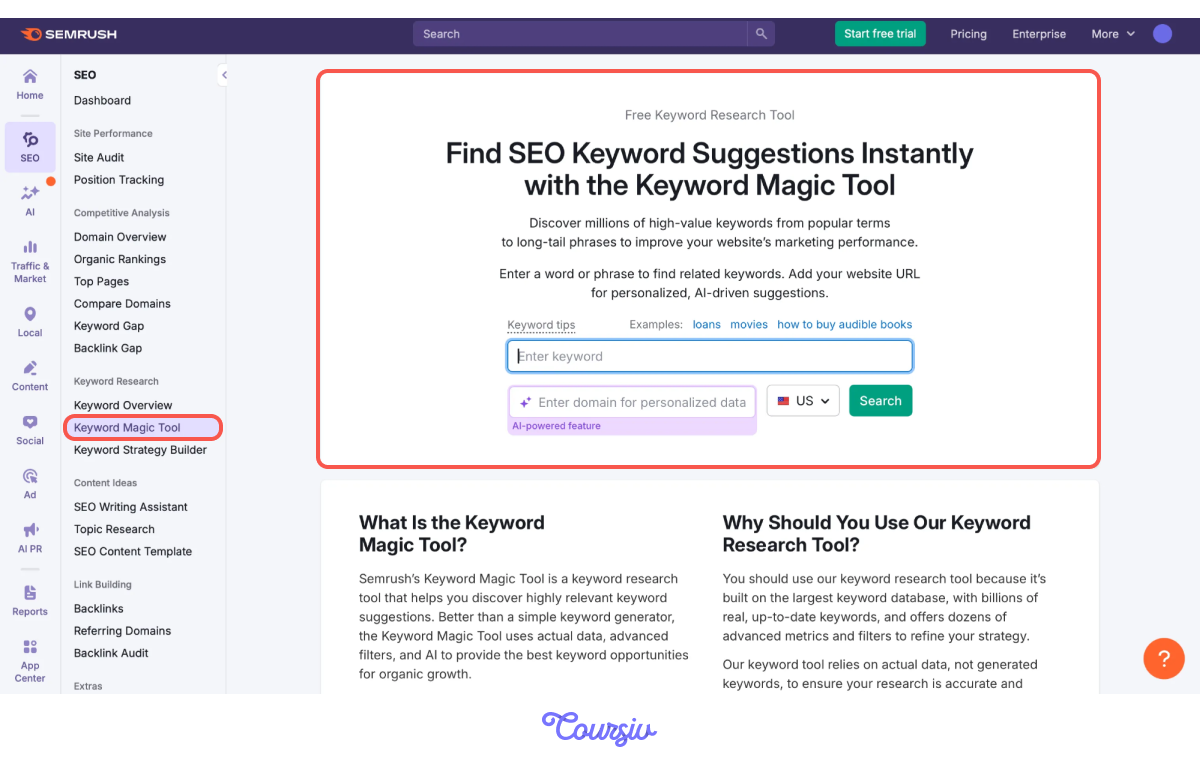
Step 1: Set Up Your Keyword Tracking Project
- Navigate to Semrush's Keyword Magic Tool in the left sidebar.
- Enter a general term related to TechFlow (e.g., "marketing automation").
- Optionally, add your website URL to enable AI-powered personalized suggestions.
- Select your target location (e.g., United States).
- Click "Search" to generate thousands of related keyword suggestions.
Your keyword research is now ready to review.
Step 2: Review Keyword Suggestions and Metrics
Review Keyword workflow:
- Enter a broad keyword related to your business.
- Browse generated keyword suggestions.
- Check search volume, difficulty, and intent.
- Export and use in campaigns and content.
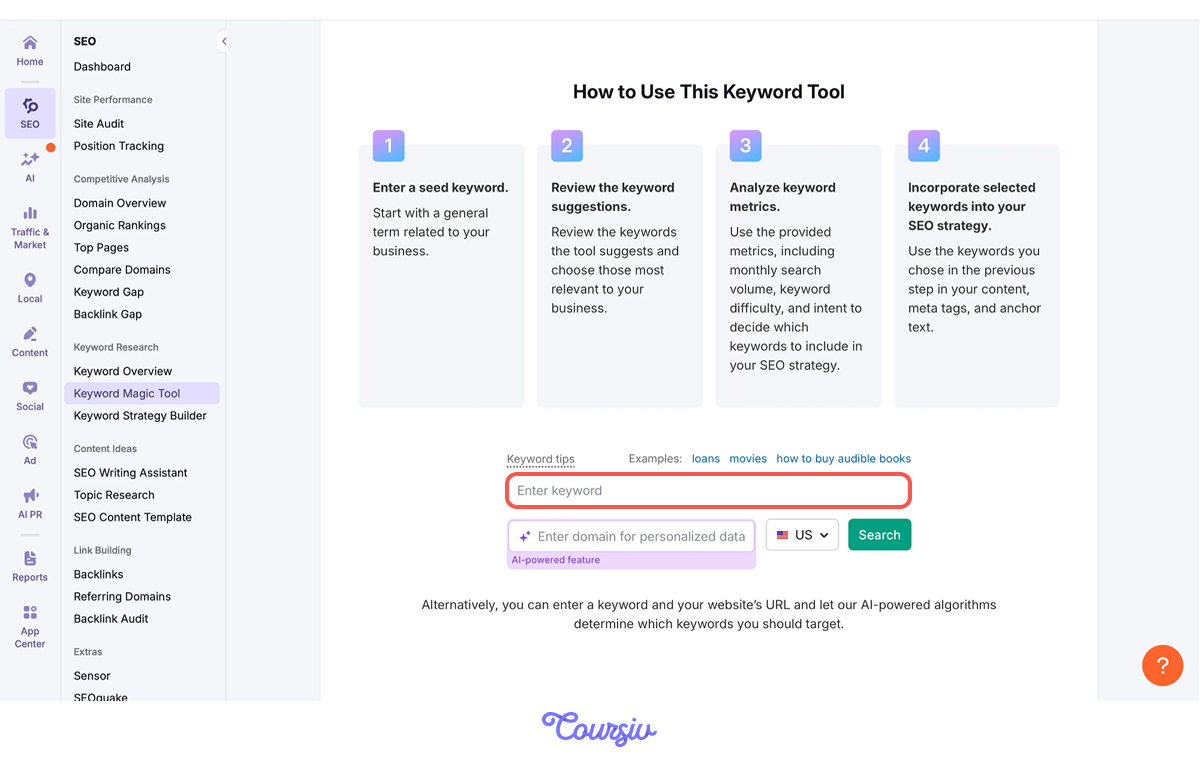
Semrush will generate hundreds of keyword opportunities with real search volume and difficulty data — keywords you'd never discover manually.
- Contextual advertising is privacy-compliant: Target based on content relevance (what users are reading now) instead of tracking individual browsing history. Works without cookies, complies with iOS 14.5 and GDPR automatically.
- Search intent determines keyword value: Informational keywords (learning) cost less but rarely convert. Commercial keywords (researching options) capture mid-funnel users. Transactional keywords (ready to buy) cost more but drive conversions.
- Use AI tools strategically: DeepSeek classifies intent at scale, Gemini validates with structured frameworks, and Semrush discovers related keywords with search volume and difficulty data you'd never find manually.
- Structure drives strategy: Three-tier keyword approach allocates budget based on intent—Core/Transactional (50%), Expansion/Commercial (35%), Awareness/Informational (15%)—ensuring you invest most in keywords that convert
Now you can answer the CEO's question, "Why do some keywords cost $15 and others $2?"
Because search intent differs. High-intent keywords like "book marketing automation demo" (ready to buy) cost $15. Low-intent keywords like "what is marketing automation" (just researching) cost $2. You pay more for clicks that convert.
In the next lesson, you'll learn how to refine who sees your ads beyond just keywords. You'll discover how Google's targeting layers work together to reach the right people efficiently, how to control costs while expanding reach, and how AI tools can automate these decisions for you. See you there!