AI Social Influence & Blogging · From Strategy to Creativity
AI Influencers and When They Win
Define your avatar's identity and positioning
From Image to Identity
In Lesson 1, you've created your first avatar concept — that's a first milestone! Now, you'll delve into giving your avatar a clear positioning statement
Here, you'll decide your avatar's role, understand when AI influencers win, and build your character profile. By the end, your character will have a complete identity.

Traditional Influencers vs. AI Influencers
As we have already discovered, influencers can be divided into two big categories: traditional and AI influencers.
Choose one
What are the key differences between traditional and AI influencers?
Indeed, AI influencers are different. They're digital personas, intentionally constructed from scratch or generated from real people's likenesses.
But it also means nothing happens by accident. Every trait, value, and visual detail must be deliberately designed.
When AI Influencers Win
AI avatars excel at:
- Consistent daily content — same energy every video
- Multilingual reach — your avatar speaks any language
- Privacy-first branding — influence without personal exposure
- 24/7 presence — posting across time zones without burnout
If your strategy relies on any of these, an AI avatar gives you a significant edge.
Choosing Your Avatar's Role
Your avatar can function as:
- A main creator — the primary face of your brand
- A co-host, appearing alongside you
- A presenter, delivering educational content
- A mascot — a recognizable brand symbol
- A channel narrator, guiding viewers through content.
The key is choosing a role that serves your positioning.
practice preview
Interactive practice
True / False
Which avatar role would best serve this positioning?
Types of AI Avatars
So, since AI avatars come in several distinct forms, each with different use cases, production requirements, and audience perceptions. Understanding these differences helps you choose what fits your brand, budget, and goals.
AI avatars can be divided into the following categories:
- Stylized and 2D Characters
- Digital Twins
- AI-Generated Humans
Let's take a closer look at each one!
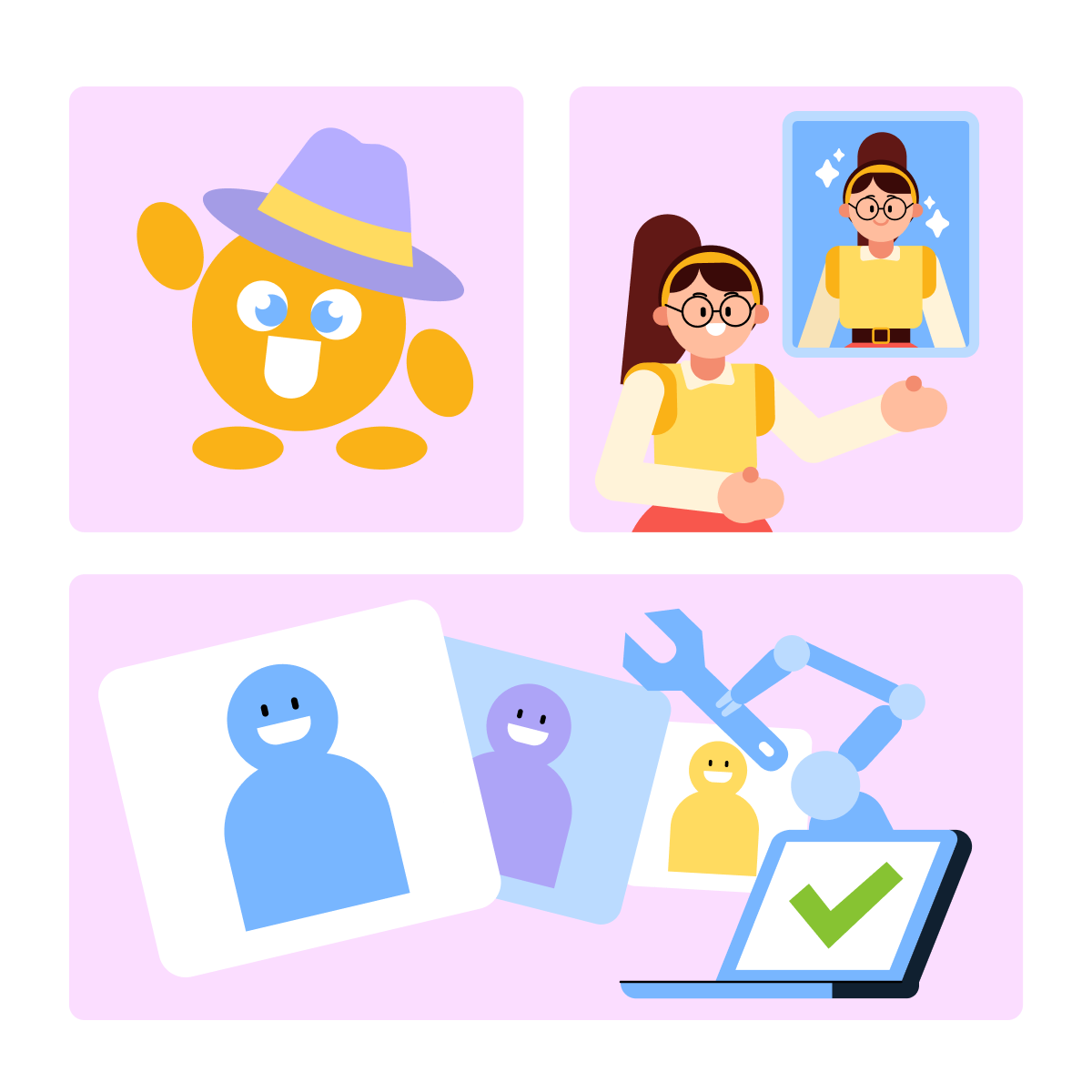
Stylized and 2D Characters
These are illustrated, cartoon-style, or anime-inspired digital characters. They have a distinctive artistic style that makes them instantly recognizable.
Tools like Canva, Adobe Character Animator, Krikey AI, or Animated Drawings by Meta can bring these to life. They're typically lower-cost, easier to maintain consistency with, and audiences immediately recognize they're animated characters.
Digital Twins
A digital twin is a photorealistic AI-generated version of a real person — often you. Using platforms like HeyGen, Synthesia, or Tavus, you can create an avatar trained on your likeness from just a few minutes of video footage.
Your digital twin can then "present" content, respond in multiple languages, and appear in videos without you having to film each one. This works beautifully for scaling your personal brand while maintaining a human connection.
AI-Generated Humans
These are fully synthetic, photorealistic characters who don't exist in real life.
You can use stock AI presenters from platforms like Synthesia or D-ID, or design a completely original character using image generators like Midjourney and then animate them with video tools.
Many successful AI influencers fall into this category: entirely fictional personas with carefully crafted backstories and visual identities.
practice preview
Interactive practice
Match pairs
Tap a left item, then a right item to match.
Each type of AI avatar serves different strategic purposes:
- A stylized 2D character builds brand recognition through a distinctive visual style and works well as a mascot.
- A digital twin amplifies your personal presence while keeping you as the brand's recognized face.
- An AI-generated human lets you create an entirely new persona with its own identity.
Some creators use multiple types for different content needs.
Fully Virtual vs. Human-Led with AI Extension
You have two strategic models:
- A fully virtual brand = your AI avatar is the entire public-facing identity — you remain behind the scenes.
- A human-led brand with an AI extension = you appear as yourself for some content while your avatar handles other content.
Choose based on your comfort level, privacy needs, and long-term vision.
Also, when using AI avatars, it is important to be transparent with the audience to build trust.
For example, you could create such a realistic AI avatar for your content that some viewers might have a question: "Wait, is this a real person or AI?"
Choose one
How do you respond to that?
The Positioning Foundation
Before deciding your avatar's role, you need solid positioning. Your positioning statement defines who you help, what transformation you offer, and why you're credible.

Strong positioning is specific. "I help everyone live better" means nothing.
In turn, "I help women create calm, elevated daily routines that fit their real lives," tells your audience exactly what to expect.
practice preview
Interactive practice
Fill in the blank
Let's use Claude to clarify your positioning.
Excellent! You've drafted the foundation of your profitable positioning.
This single sentence will guide every piece of content you create — whether you deliver it yourself or through an AI avatar.
Before deciding your avatar's role, you need solid positioning. Why? Let's answer this question in the next task
Choose one
What makes a positioning statement effective for monetization?
What Is a Character Profile?
Now that you've figured out your positioning, let's move on to character building!
A character profile is your avatar's DNA. Just like a TV show's writers keep a profile to ensure characters stay consistent across episodes and seasons, your character profile captures everything about your avatar — their personality, values, visual standards, and voice.
Successful AI influencers are led by clear rules:
- Defined values — what they stand for and against
- Voice guidelines — how they speak and their tone
- Visual standards — consistent appearance across all content
- Content pillars — topics they cover and avoid
Document these in your character profile before creating more content.

practice preview
Interactive practice
Fill in the blank
Use Claude to draft the foundation of your avatar's character profile.
Perfect! You now have the foundation of your character profile. Save this document and reference it every time you create content — it's your consistency insurance.

Choose one
Why is a character profile essential for AI influencers specifically?
Meet Aria!
Look at what you've accomplished. You've crafted your positioning, explored avatar types, chosen Aria's role, mapped her strategic use cases, and built her character profile. She has a name, a personality, values, and a voice — all documented and ready to guide your content.
In the next lesson, you'll dive into building your complete brand identity and connecting more deeply with your audience.
Let's keep building!