AI Copywriting · Copywriting Across Formats
SEO and Headlines
Keywords, intent, and headline formulas
Headlines That Rank and Click
Imagine this: you write a sharp landing page. The copy is clear, the CTA is strong, the proof is specific, but traffic is flat. No one's finding it. That's the gap SEO fills: connecting great copy with the people already searching for it.
Welcome to Unit 2! You'll apply the foundation you've built in Unit 1 across various copywriting formats, starting with the element that determines whether your copy gets seen at all — the headline.

A Note on Unit 2
Throughout Unit 2, every lesson focuses on a specific copywriting format. The examples and exercises are designed for B2C (business-to-consumer).
However, every format has important B2B (business-to-business) differences — in tone, proof, CTAs, and audience psychology. Each lesson includes a dedicated section on what changes when you're writing for business buyers.
Watch for those sections — they'll help you adapt your skills for both markets.
Select all that apply
Why do you think headlines deserve special attention in the copywriting process?
Headlines sit at the intersection of reader attention and search visibility. That's why writing them well requires understanding both. Let's start with the search side — the SEO fundamentals every copywriter needs to know.

SEO Fundamentals for Copywriters
SEO (Search Engine Optimization) is about making your copy visible to people who are actively searching for what you offer. For copywriters, you don't need to become a technical SEO expert.
You just need to understand three things:
- Search intent
- Keywords
- The balance between writing for humans and search engines
Search Intent
Search intent is the reason behind a search query — what the person wants when they type something into Google. This is the most important concept for SEO copywriting, because if your headline and page don't match the searcher's intent, they'll click away immediately — and search engines will notice.
There are four main types of search intent:
- Informational: The searcher wants to learn something (e.g., "how to write email subject lines").
- Commercial: The searcher is researching options before buying (e.g., "best email marketing tools").
- Transactional: The searcher is ready to act (e.g., "Mailchimp pricing plans").
- Navigational: The searcher is looking for a specific page (e.g., "Mailchimp login").
As a copywriter, you'll mostly write for informational, commercial, and transactional intent. Each one requires a different headline approach.
practice preview
Interactive practice
True / False
What type of search intent does this query have?
practice preview
Interactive practice
True / False
What type of search intent does this query have?
practice preview
Interactive practice
True / False
What type of search intent does this query have?
Keywords
The next step is the keywords. A keyword is the word or phrase someone types into a search engine. Your job as a copywriter is to identify the keywords your audience uses, then weave them naturally into your headlines and copy.
Attention to "naturally". Stuffing keywords into awkward sentences hurts readability and can actually damage your search rankings. Modern SEO rewards copy that reads well to humans while including relevant terms.

Using Semrush's Keyword Magic Tool
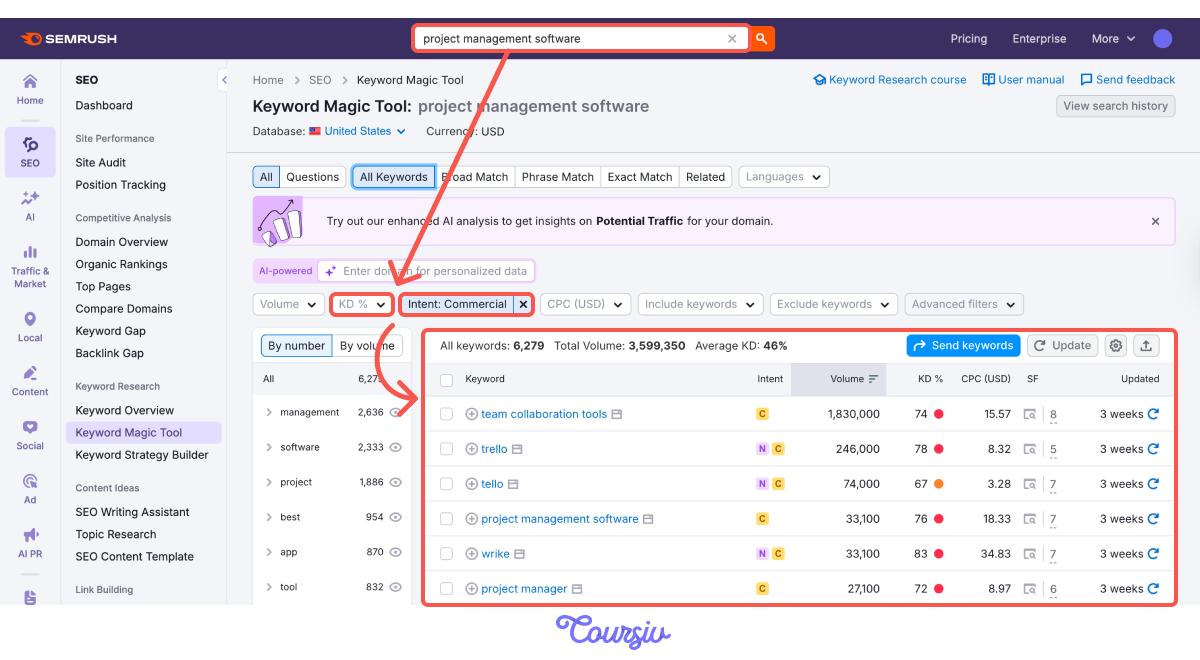
Let's find real keywords to write for. Meet Semrush's Keyword Magic Tool that helps you turn one topic into a big list of related keyword ideas, so you can quickly find what people search for. It also shows helpful metrics such as search volume, difficulty, and intent type.

Keyword Research Workflow
Let's see how to find your target keyword in the Keyword Magic Tool:
- Enter a broad seed keyword related to your topic (e.g., "project management software").
- Filter by intent: select Commercial if you're writing a comparison page, Informational for a how-to guide, or Transactional for a product page.
- Sort by keyword difficulty to find terms you can realistically rank for.
- Pick a keyword with reasonable search volume that matches your page goal.
Great!
Notice how the Intent column guided the keyword choice. If you'd picked an informational keyword like "what is project management" for a comparison page, the content wouldn't match what the searcher is looking for, and they'd bounce. Intent alignment is the foundation of SEO copywriting.
Headline Formulas
With your keyword and intent locked in, it's time to write headlines. Proven headline formulas give you a reliable starting structure, and AI can generate dozens of variations from each one.

Here are four formulas that consistently perform across formats:
- How-To: How to achieve an outcome without a common objection — works for informational intent (e.g., "How to Improve Email Open Rates Without Growing Your List")
- Listicle: Number of things that deliver results — works for informational and commercial intent. (e.g., "9 Email Marketing Tools That Actually Save You Time”)
- Direct Benefit: Specific outcome for a specific audience — works for commercial and transactional intent. (e.g., "Faster Campaign Reporting for In-House Marketing Teams”)
- Question: A Pain point question and a specific promise — works across all intent types. (e.g., "Tired of Low Open Rates? Here's What Top Marketers Do Differently”)
Each formula serves a different intent. Matching the formula to the intent gives your headline the best chance of ranking and clicking.
Choose one
You're writing a headline for the keyword "best email marketing tools" (commercial intent). Which formula fits best?
practice preview
Interactive practice
Fill in the blank
Feed your target keyword and search intent into an AI prompt to generate multiple headline options using proven formulas.
Excellent!
Seven variations, each using a different formula, all including the keyword naturally, and all aligned with commercial intent. This is how AI accelerates headline writing: you provide the strategic direction, and AI produces the volume for testing.
Writing for Humans and Search Engines
A common trap in SEO copywriting is writing headlines that rank well but read awkwardly, or headlines that sound great but miss the keyword entirely. The best SEO headlines do both.

Here are three rules for balancing search and readability:
- Lead with the keyword when possible: "Best Project Management Tools..." is stronger than "Here Are Some Tools for Project Management..."
- Aim for 50-60 characters: Titles longer than roughly 60 characters often get truncated in Google search results. Keeping your headline within 50-60 characters ensures it is fully visible.
- Write for the click, not just the rank: A headline that ranks high, but nobody clicks is still failing. The headline needs to promise something specific enough to earn the click.
practice preview
Interactive practice
Fill in the blank
Take a headline that reads well but isn't SEO-optimized and rewrite it to include the target keyword while keeping it compelling.
Great Work!
The keyword now leads the headline, it fits within the character limit, and it still reads naturally. That's the balance — search engines see relevance, readers see a clear promise.
B2B Headlines — What Changes
Everything you've learned applies to B2B headlines too: keyword research, intent matching, and proven formulas still work. The differences are in tone, specificity, and what the reader values.

B2B readers are typically evaluating solutions for their team or company, not for themselves personally. They care about ROI, efficiency, risk reduction, and how to justify the decision to stakeholders.
This changes the headline approach:
- B2C: "7 Best Meal Kit Deliveries for Busy Parents"
- B2B: "7 Best Project Management Tools for Enterprise Teams (Ranked by ROI and Scalability)"
B2B headlines often include qualifiers like company size, industry, or business outcome. The formulas stay the same — the specifics inside them shift toward professional decision-making.
practice preview
Interactive practice
True / False
Which audience is this headline written for?
practice preview
Interactive practice
True / False
Which audience is this headline written for?
- Keyword research with Semrush gives your headlines a data-backed foundation — target the right terms before you write.
- Search intent determines your headline's angle: informational, commercial, and transactional queries need different approaches.
- Proven formulas (how-to, number, question) give AI structure to generate dozens of testable variations.
- SEO + copy balance is important. A headline needs to rank and compel a click.
- B2B headlines shift in tone and specificity but follow the same structural principles.
Next Steps
In the next lesson, you'll build on your headline skills and create full landing pages — structuring every section from hero to CTA for maximum conversions, with AI generating and refining each element.
Let's keep going!