AI Copywriting · Copywriting Across Formats
Long Form Content
Long-form structure and coherence
Long-Form Content With AI
A reader finds your article through a search, skims the intro, and stays for 12 minutes. They read every section, click the CTA at the bottom, and bookmark the page. That's what well-structured long-form content does.
In this lesson, you'll learn how to plan long-form content with structured briefs and outlines, draft sections with AI, maintain coherence across thousands of words, and write long-form product pages.

Select all that apply
Why does long-form content need a different writing process than short-form copy?
The Long-Form Workflow
Long-form content — articles, guides, whitepapers, and extended product pages — spans thousands of words. The principles are the same with the short-form content, but the process has to change.
In Lesson 1, you learned the core cycle: Brief → Draft → Critique → Rewrite. For short copy, you can sometimes do this in one pass.
For long-form content, expand the workflow by adding an Outline step after Brief. It's the bridge between knowing what you want to say (the brief) and actually writing it (the draft).
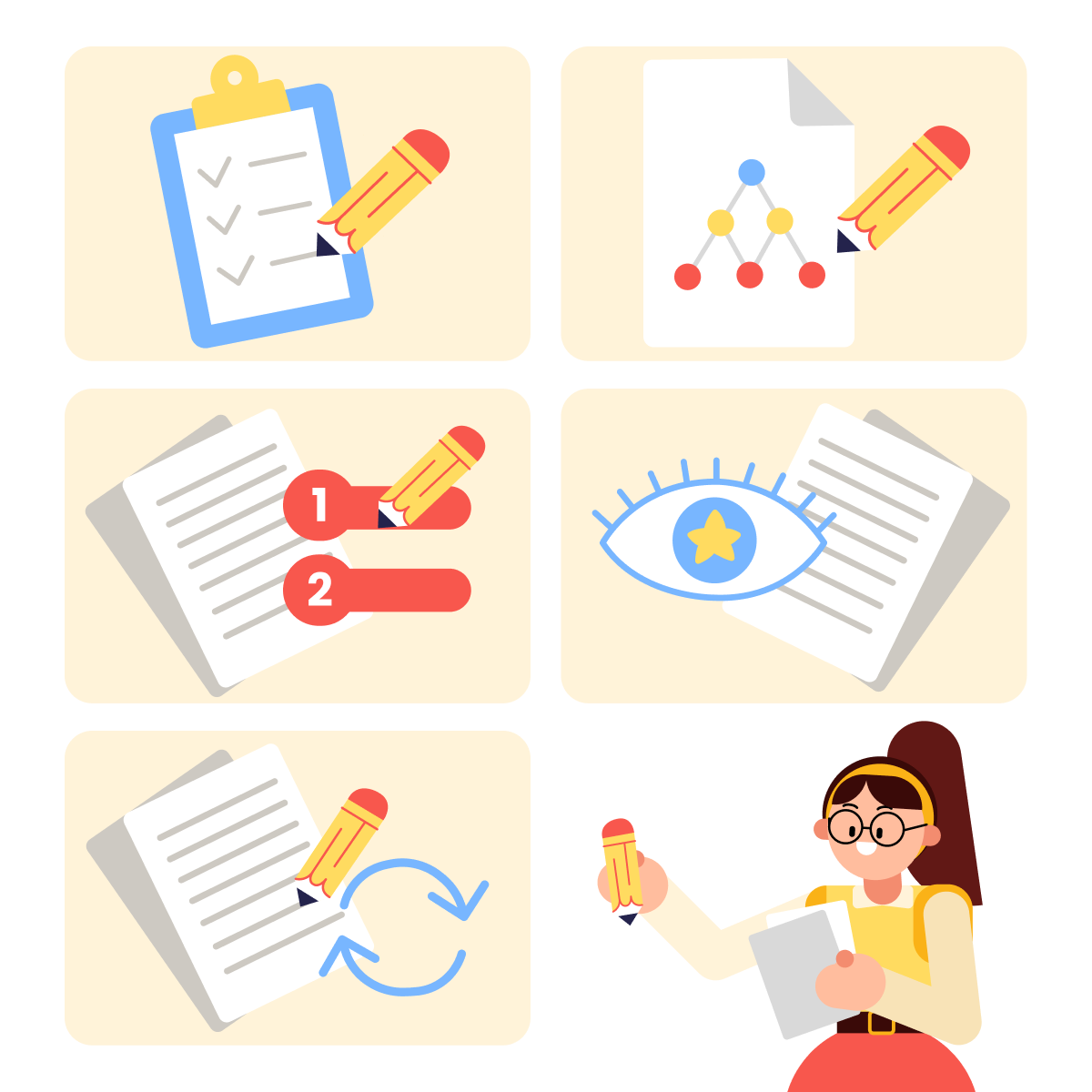
The Power of an Outline
An outline turns your brief into a structure. It's a list of sections, each with a clear purpose, arranged in the order the reader needs them.
A useful outline includes:
- Section heading: What this section is about.
- Purpose: What it does for the reader (introduces the problem, teaches a concept, provides proof, drives action).
- Key points: 2-3 bullets on what the section covers.
This level of detail matters. An outline that just lists headings ("Introduction, Benefits, How It Works, Conclusion") doesn't give you or AI enough direction to draft well.

practice preview
Interactive practice
Fill in the blank
Use ChatGPT to brainstorm an outline structure.
Notice how each section has a job. The outline is a sequence of purposes: hook, educate, guide, enable, commit. That structure keeps the reader moving forward and prevents sections from overlapping.
Section-by-Section Drafting
One of the typical mistakes while working with long-form content is pasting the whole brief into a prompt and asking AI for a complete 1500-word article in one shot.
As a result, generic openings, repetitive middle sections, and a conclusion that restates the introduction. AI writes better when you give it one section at a time with clear context.

The section-by-section approach:
- Share the full outline with AI, so it knows the overall structure.
- Ask it to draft one section at a time.
- Review each section before moving to the next.
- Reference what's already been written so the AI doesn't repeat itself.
This takes slightly longer than a one-shot draft, but the quality difference is significant.
practice preview
Interactive practice
Fill in the blank
Use Claude to draft one section of your article with full context.
Great!
Section-by-section drafting works: each part does its job, because the AI knows what came before and what comes next.
Maintaining Coherence
The biggest risk in long-form content is drift — when sections start to feel like separate blog posts stitched together instead of one continuous piece. Three things prevent drift.
- Consistent voice: Set the tone in the brief and reinforce it in every section prompt.
- Transitions: Each section should connect to the one before it. A simple bridge sentence keeps the reader oriented.
- No repetition: If you made a point in Section 2, don't make it again in Section 4. Paste previous sections into the prompt so AI knows what's been covered.
Choose one
You're reviewing a long-form article draft. Section 3 ends with "choosing the right app matters." Section 4 opens with "Setting up your first automated budget is straightforward." What's the problem?
Long-Form Product Pages
Let's apply these principles to product pages. High-consideration products — enterprise software, premium DTC products, professional services — need longer pages because the decision is bigger. A $3000 mattress or a SaaS platform needs more information than a phone case.
Bigger decision = more information needed. Long product pages expand every section from the standard structure, especially:
- Hero: longer headline + supporting paragraph + primary CTA
- Social proof: multiple types (testimonials, case studies, logos, data points)
- Detailed specs: comparison tables, integration lists, technical documentation
- Multiple CTAs: placed throughout the page, not just at the bottom
practice preview
Interactive practice
Fill in the blank
Use Claude to draft the hero section for a high-consideration product page.
Excellent!
Notice how that hero works because it follows the message triangle:
- Offer (7-zone adaptive foam mattress)
- Outcome (wake up without stiffness)
- Proof (Sleep Foundation rating + 14K reviews)

Editing Long-Form Content
Let's move on to the next step: editing. Long-form editing has two passes:
- Pass 1 — Structure and flow. Read the full piece from top to bottom. Check: Are there gaps or repetition? Do transitions connect sections smoothly?
- Pass 2 — Line-level quality. Apply the six-point rubric from Lesson 5: Clarity, Specificity, Offer strength, Proof, Structure, and CTA. Cut filler. Make every paragraph earn its place.
practice preview
Interactive practice
Fill in the blank
Use Claude to review the section you drafted earlier against the copy rubric from Lesson 5.
B2B Long-Form Content — What Changes
- Briefs include stakeholder roles because B2B content often needs to speak to multiple decision-makers.
- Outlines often include an executive summary section — senior leaders may only read the top.
- Proof means named companies, revenue metrics, and implementation timelines — not individual testimonials.
- CTAs are lower commitment — "Download the full report," "Book a strategy call," "Share with your team."
practice preview
Interactive practice
True / False
Which audience is this content written for?
practice preview
Interactive practice
True / False
Which audience is this content written for?
Principles for every long-form piece you write:
- Brief before outline, outline before draft. Every long-form project needs both planning stages — skipping them costs more time than it saves.
- Draft section by section. One section at a time, with context from previous sections, produces dramatically better results than one-shot generation.
- Transitions prevent drift. Bridge sentences between sections keep 2000 words feeling like one continuous piece.
- Match page length to decision weight. High-consideration products (enterprise SaaS, premium DTC) need more proof, more objection handling, and more detail.
- Edit in two passes. Structure and flow first, then line-level quality with the six-point rubric.
Next Steps
In the final lesson, you'll bring everything together. You'll learn how to build a portfolio that showcases your AI copywriting skills, find and pitch clients, set your rates, and navigate the ethics of AI-assisted work. It's time to turn these skills into a business.
Let's finish strong!