AI Copywriting · Copywriting Across Formats
Ad Copy
Ads that stop the scroll
Ad Copy That Converts
Imagine you launch an ad campaign, but it doesn't stop anyone mid-scroll. With ads, every impression costs money, so every word needs to earn its place.
In this lesson, you'll learn how to match ad copy to the reader's awareness level, write high-converting ads across platforms, and generate variations at scale with AI.

What Is Ad Copywriting?
Digital ad copywriting is writing short, paid content designed to earn a click, a sign-up, or a sale across platforms like Meta, Google, and LinkedIn.
Unlike organic posts or emails, every ad impression costs money. That changes the stakes: you need to know exactly who you're writing for, what they already know, and what will make them act.
Awareness Levels
The single most important concept in ad copywriting is awareness level — how much the reader already knows about their problem, your solution, and your product. The right message to the wrong awareness level will fail, no matter how well it's written.
There are five awareness levels, originally defined by copywriter Eugene Schwartz. Each level needs a different opening message:
- Unaware: Doesn't know they have a problem. Lead with a relatable situation.
- Problem-aware: Knows the problem, not the solution. Name the problem directly.
- Solution-aware: Knows solutions exist, hasn't found yours. Differentiate your approach.
- Product-aware: Knows your product, hasn't decided yet. Overcome the remaining objection.
- Most aware: Ready to act, needs the right offer. Make the offer.
practice preview
Interactive practice
Match pairs
Tap a left item, then a right item to match.
Ad Copy Structure
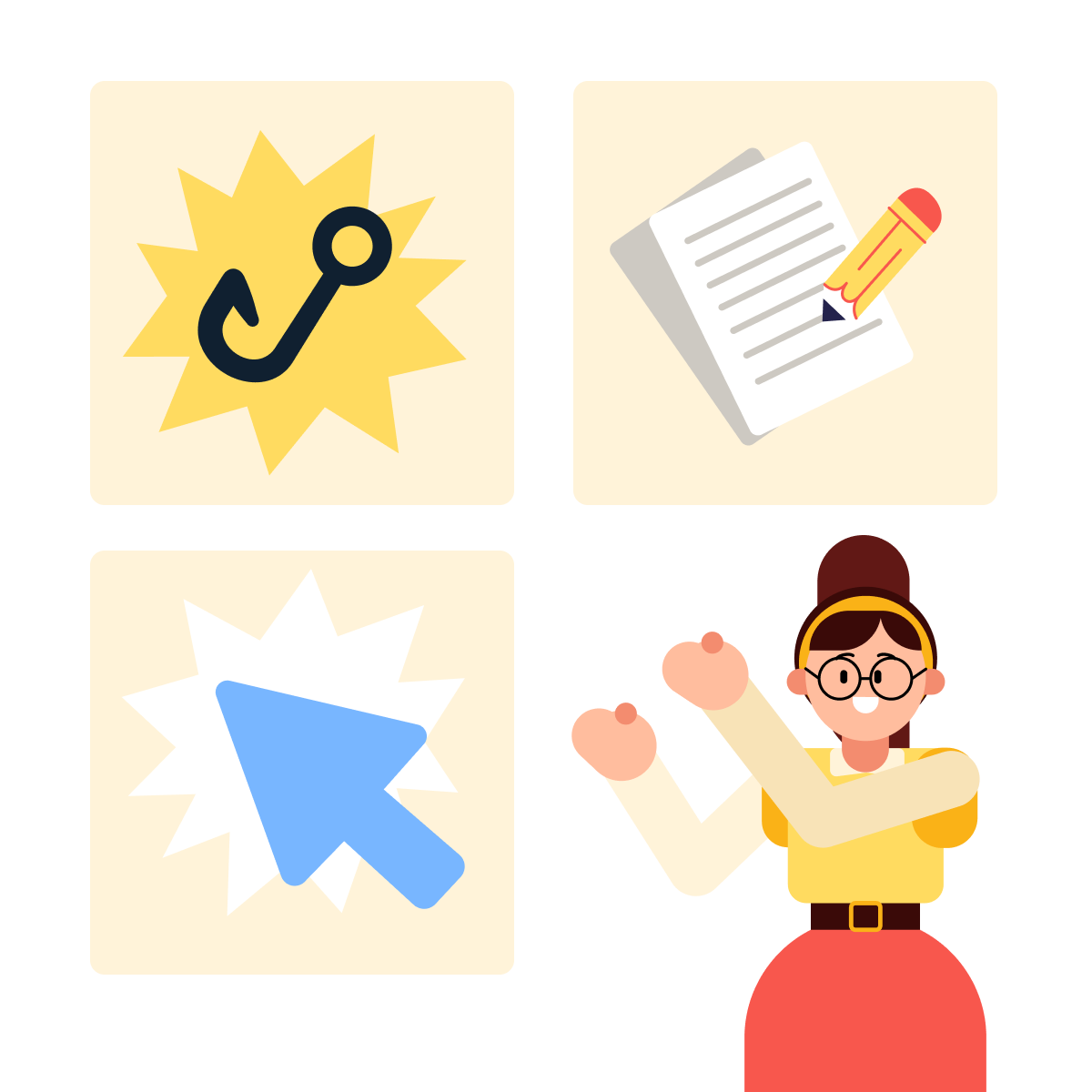
Regardless of platform, most ads follow the same three-part structure you already know: Hook, Body, and CTA.
practice preview
Interactive practice
Fill in the blank
Use ChatGPT to generate ad variations for different awareness levels.
Great!
Same product, three completely different ads — because the audience's awareness level changed. Matching awareness to message is what separates ads that convert from ads that waste budget.
Writing for Specific Platforms
The three-part structure (hook, body, CTA) adapts to each platform's format and audience behavior. Let's look at the three most common ad platforms.

Meta (Facebook / Instagram) Ads
Meta ads appear in a visual feed.
The primary text is your main copy — the hook must stop the scroll instantly. Typically, you also have a short headline and a CTA button.

- Lead with the hook in the primary text — the first line is all that most people see.
- Keep primary text under 125 characters to avoid "See more" truncation.
- Use the headline to reinforce the benefit, not repeat the primary text.
- CTA button should match the awareness level ("Learn More" for cold, "Sign Up" for warm).
Google Search Ads
Google Search ads meet the reader at the moment of intent — they've typed a query, so awareness is already higher. Your ad competes against other search results for the click.
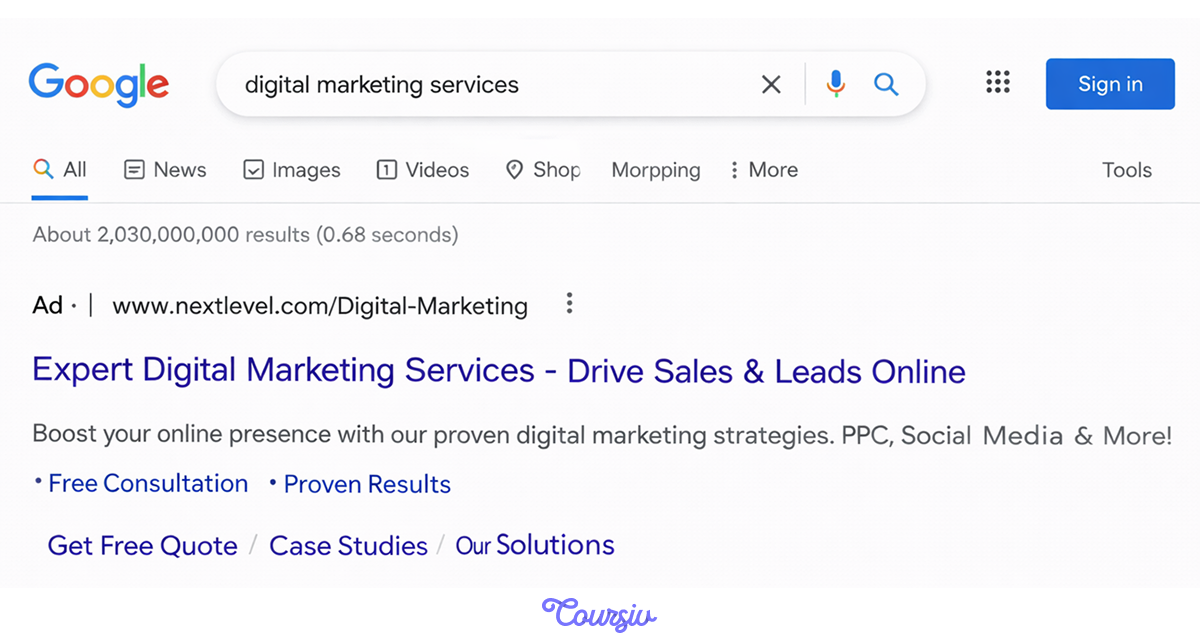
- Include the target keyword in the headline — match what the reader searched.
- Use the description to deliver a specific benefit and proof point.
- Make the CTA action-specific: "Get your free quote" beats "Learn more."
- Focus on differentiation — the reader is comparing you against other results on the same page.
LinkedIn Ads
LinkedIn ads reach a professional audience. They work best for B2B offers — demos, whitepapers, webinars, case studies. The reader is in a professional mindset, so the copy should reflect that.
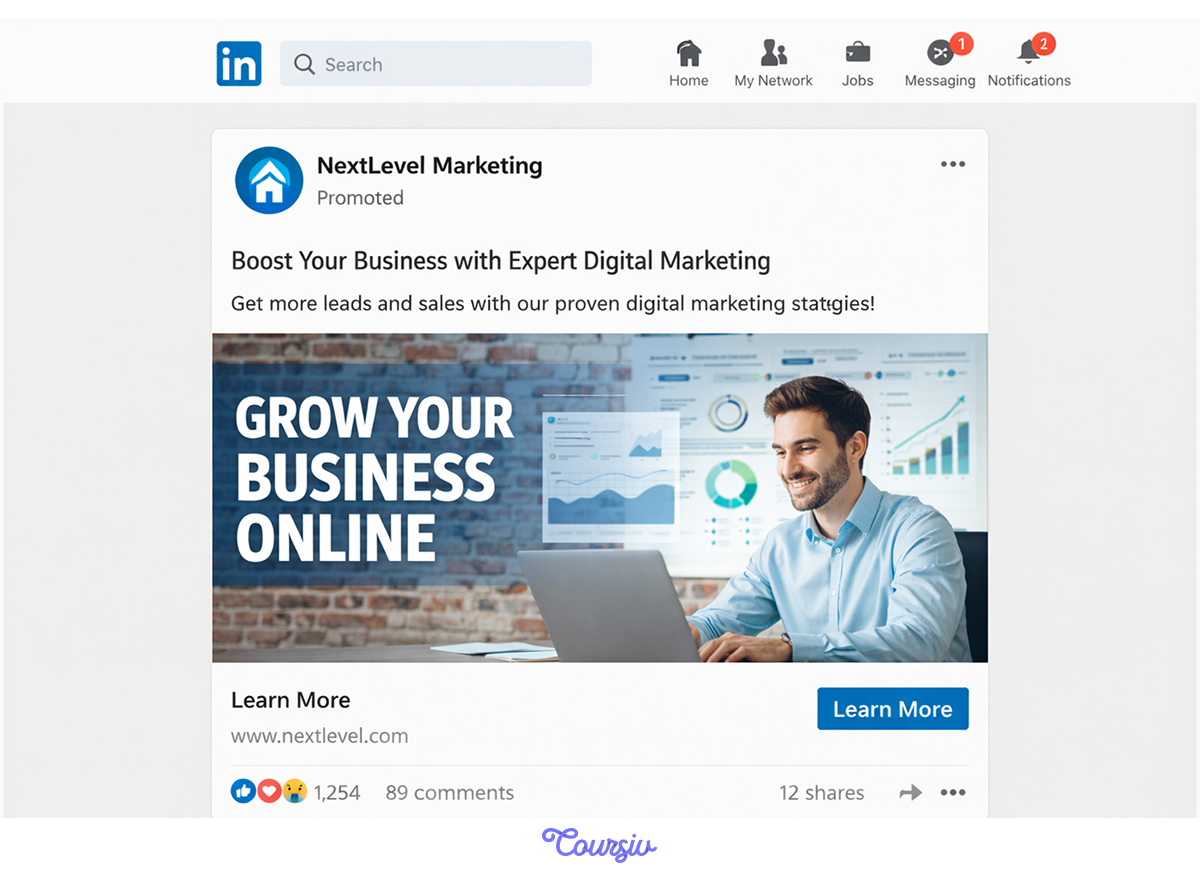
- Lead with a business outcome or peer signal: "How 340 finance teams cut close time by 60%."
- Name roles or industries for relevance: "For marketing leaders at mid-market SaaS companies."
- CTA should be low-commitment: "Download the report," "Watch the case study," "Book a 15-minute call."
Choose one
You're writing a Meta ad for a solution-aware audience. Which hook works best?
Generating Variations With AI
Ad copy is a volume game. You don't write one perfect ad — you write many variations and test which ones perform. AI makes this fast. The key is giving AI a clear angle for each variation.
An angle is the specific entry point into your message — the particular benefit, fear, desire, or scenario you lead with. Same product, different angles:
- Time angle: "Meal planning in 10 minutes, not 2 hours."
- Money angle: "Families save $120/month on groceries with Mealwise."
- Identity angle: "For parents who'd rather cook than plan."
- Fear angle: "Another week of takeout? There's a better way."
Each angle resonates with a different segment of your audience.
practice preview
Interactive practice
Fill in the blank
Use Copy.ai to generate multiple ad variations from different angles.
Excellent!
This is a systematic approach to building an ad-testing library. Test each angle, see which resonates, then write more variations of the winner.

Scoring Ads With Anyword
Writing variations is half the job. The other half is predicting which ones will perform before you spend budget testing them.
Anyword is an AI platform that scores ad copy based on predicted performance — giving each variation a score before it runs.
Meet the typical Anyword workflow:
- Generate your ad variations in the platform.
- Anyword scores each one.
- Use scores to prioritize which variations to test with real budget.
- After testing, feed results back to improve future predictions.
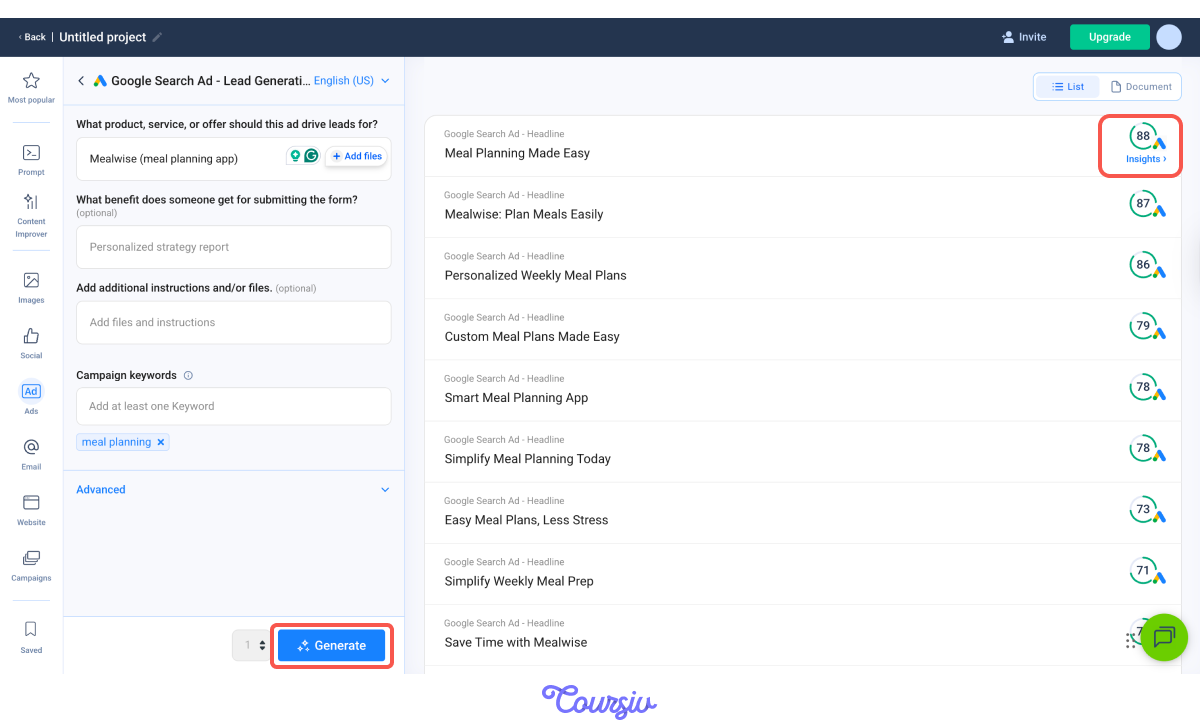
It's not a replacement for real testing but an important technique that helps you test smarter by eliminating weak variations before they cost money.
practice preview
Interactive practice
Put in order
Arrange these steps in the correct order for an efficient ad testing process.
B2B Ads — What Changes
- Hook: Lead with a business outcome or peer company. "How Shopify's ops team cut reporting time by 70%."
- Body: Emphasize ROI, efficiency, or risk reduction. Mention team size, industry, or role for relevance.
- CTA: Low commitment. "Download the case study," "Book a 15-min demo," "See it in action."
- Platform: LinkedIn ads and Google Search ads dominate B2B. Meta works for retargeting.

practice preview
Interactive practice
True / False
Which audience is this ad written for?
Principles for every ad you write:
- Match the message to the awareness level. Unaware readers need a relatable scenario; most-aware readers need the offer. Getting this wrong wastes budget.
- Hook matters. If the first line doesn't stop the reader, everything after it is invisible.
- Test angles, not just wording. Time, money, identity, and fear are different entry points into the same product. Test which resonates.
- Score before you spend. Use Anyword to filter weak variations before running live tests.
- Platform shapes format, not principles. Meta is visual-feed. Google is intent-driven. LinkedIn is professional. Same structure, different execution.
Next Steps
In the next lesson, you'll work at the opposite end of the length spectrum — long-form content. You'll learn how to plan, outline, and draft articles, guides, and long product pages section by section with AI, keeping quality and coherence across thousands of words.
Let's keep going!