AI in SMM · Learning from Results and Scaling
Interpreting Marketing Data
Find meaning in performance data
Analytics with AI
Welcome to Unit 3! Now that you've tried AI across Instagram, TikTok, Facebook, and YouTube, it's time to move to the next level — analyzing your performance and making efficient further decisions.
In this lesson, you'll learn how to use AI to interpret performance data, spot meaningful patterns, and turn raw metrics into clear, actionable decisions for your social media strategy.

Why Metrics Need Interpretation
Raw metrics show you what happened. Engagement rates, reach, saves, comments — these are numbers that don't explain why one post performed better than another or what you should do differently next time.

Choose one
You're reviewing your TikTok analytics and notice that your last five videos have very different engagement rates. What's the most effective way to turn this data into actionable insights?
Organizing Data for Analysis
The real value comes from connecting numbers to patterns: which themes resonate, which formats drive action, and when your audience is most engaged.
But when posts are scattered across screenshots or inconsistent spreadsheets, AI can't reliably surface those connections.
Start by organizing your content into clear categories: theme, format, platform, date, and engagement metrics, so AI can accurately identify what's working and reveal patterns that aren't immediately apparent.

AI tools like Claude and ChatGPT are excellent at categorizing by themes — but they need clean, structured data to work with. This is where Gemini in Google Sheets comes in. Let's try it!
practice preview
Interactive practice
Fill in the blank
Ask Gemini in Google Sheets to organize your posts by theme.
Excellent!
You've identified clear patterns in themes that work. But not every pattern you notice is real.
Small sample sizes can fool you into seeing patterns that don't exist. Imagine: you post workout content on Monday — 840 likes. Same topic Thursday — 190 likes.
Does Monday always outperform Thursday? Let's use ChatGPT to evaluate whether a pattern is statistically meaningful or likely due to random variation.

practice preview
Interactive practice
Fill in the blank
Ask ChatGPT to assess if a pattern is reliable or random.
Identifying a potential pattern is only step 1. Step 2 is validation. Without structured testing, you risk making decisions based on incomplete data or chasing trends that don't actually work for your audience.
Let's take the next step: turning that insight into a concrete action plan to test whether the pattern holds.
practice preview
Interactive practice
Fill in the blank
Now that the pattern seems test-worthy, use ChatGPT to design a clear, minimal test.
You've learned how to validate patterns and separate real signals from randomness. But what happens when you're just starting out and the data is still limited?
That's where learning to work with small datasets becomes essential.
Small Datasets
Even limited data can reveal directional signals: clues about what's worth testing as your online presence grows. AI helps extract those early signals and suggests what to track next.
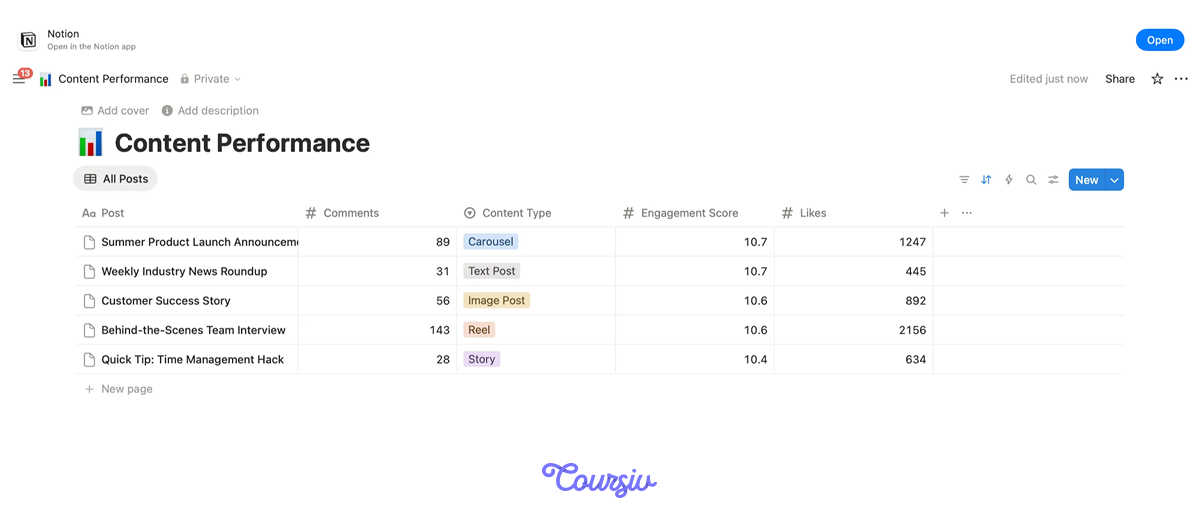
Now, imagine you asked Notion AI to create a content performance table with five social media posts, categorized by content type, likes, comments, and engagement score. Let's ask it to analyze and summarize the feedback on what's working.
practice preview
Interactive practice
Fill in the blank
Ask Notion AI to create a content plan based on the table.
Nice work! Small datasets won't give you statistical certainty, but they can still reveal early signals worth testing.
Choose one
What's the right approach to insights from small datasets?
Gemini in Google Sheets helped us analyze large datasets to identify broad performance patterns, while Notion AI surfaced early signals and content hypotheses from smaller datasets.
With this process, you're equipped to analyze performance thoughtfully and intentionally scale what works.

- AI transforms raw metrics into strategic insights by connecting numbers to content decisions.
- Real patterns emerge when you connect metrics to content choices, not just raw numbers.
- Small datasets reveal early signals — treat them as hypotheses to test, not proven facts.
- You can extract actionable next steps even with limited data — no need to wait for 100+ posts.
What's Next?
Good job! Now, you can read beyond the numbers and spot what's working.
Next, you'll learn how to find and land clients! That's where real people management lives.