Claude · Claude in Practice
Understanding, Research, and Synthesis
Turn information into insight
From Information to Insight
You're trying to figure something out, and you've gathered articles, advice, and conflicting opinions. But what's next?
Most tools are good at summarizing one thing at a time — but the real challenge is thinking across everything at once, seeing how the pieces relate. That's where Claude is at its strongest: holding many sources in view and reasoning about what they actually mean together. Let's see how!

Scenario: Conflicting Health Advice
You've been feeling tired lately. You want to understand why and what to do about it.
So you search online.

You find:
- An article saying you need more sleep
- Another saying it's probably your diet
- A third claiming it's lack of exercise
- One more suggesting it might be stress
Everyone sounds convincing, but no one agrees.
Choose one
What's the actual problem here?
You could spend hours rereading everything, taking notes, trying to remember what each source said.
Or you could try something different — a faster way to make sense of it all without wasting your mental energy.
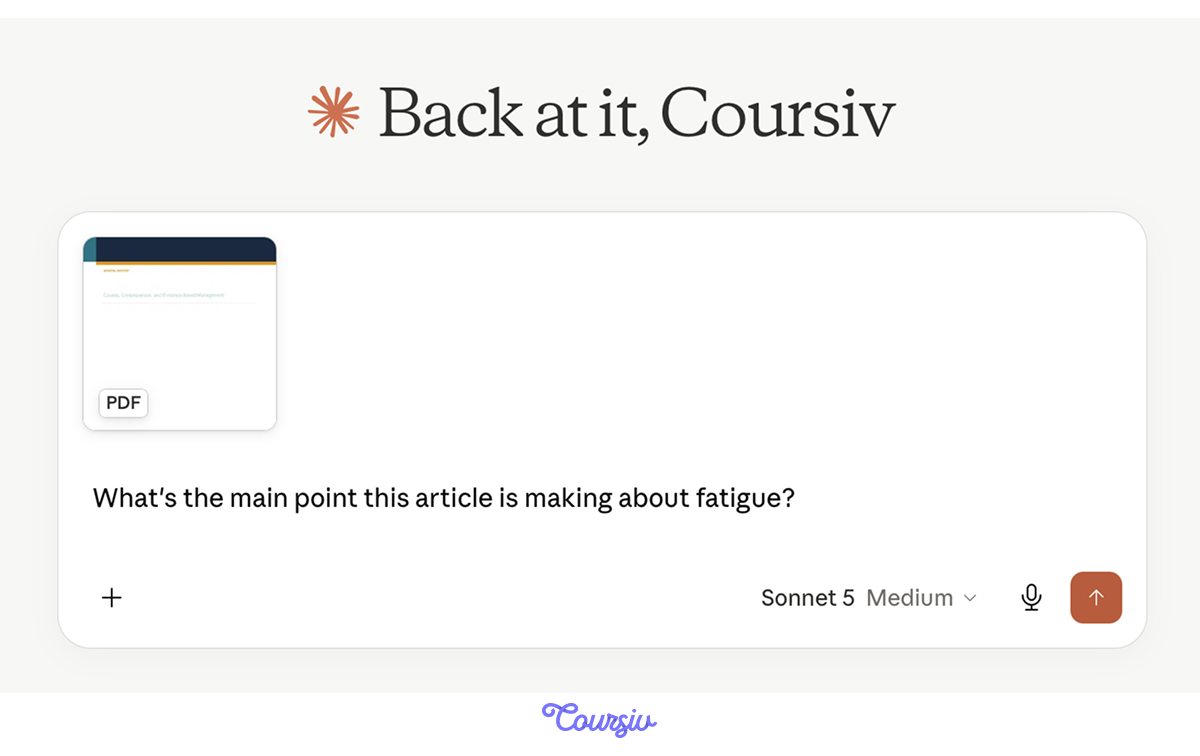
You copy the first article into Claude.
Instead of asking for a summary, you ask: "What's the main point this article is making about fatigue?"
Claude responds:
"This article argues that chronic fatigue often stems from sleep debt — not just sleeping too little one night, but consistently getting less sleep than your body needs over weeks or months. The key idea: your body keeps a 'sleep account' that compounds over time."
That's not what the article said word-for-word — it's what the article meant.
practice preview
Interactive practice
True / False
Review the part of the text above and decide whether it's a summary or an interpretation.
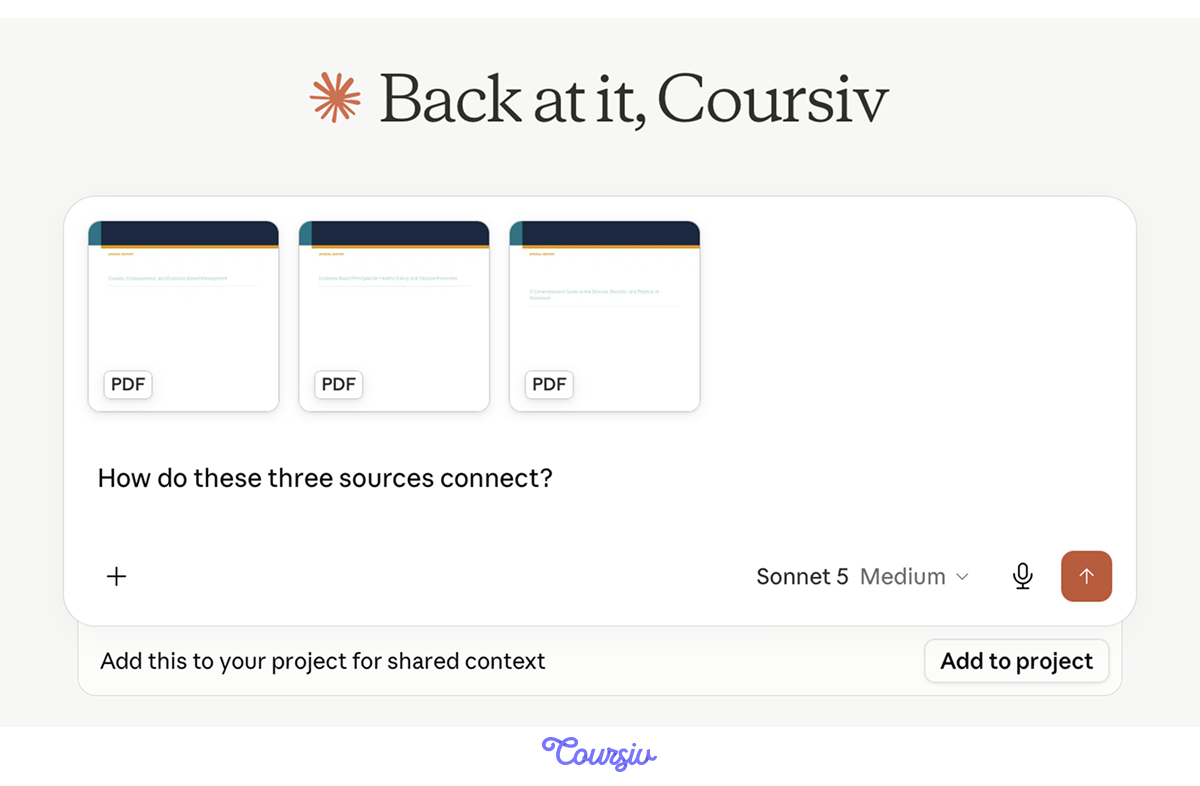
Now you paste two more sources — the diet article and the one about exercise.
You ask: "How do these three sources connect?"
Claude responds:
"All three identify fatigue as a symptom of resource depletion. Sleep article: depleted recovery time. Diet article: depleted nutrients. Exercise article: depleted cardiovascular capacity. The connecting thread: your body is running low on something it needs to function."
See how this works? Instead of three separate summaries, Claude showed you the pattern linking them.
Worth pausing on why that's synthesis and not three summaries.
Two things made it work. First, you asked "how do these connect?" — pointing Claude at the relationships, not asking for three recaps.
Second, you gave it all three sources together, so it could actually see across them. That second part is a skill in itself: how you package what you hand Claude shapes what it can find. Feed sources one at a time and it can't connect them; give them together, clearly separated, and it can.
Choose one
What's the best thing about this approach instead of reading three summaries separately?
When You Don't Understand Something
Sometimes you encounter a term you don't fully understand. For example, the stress article keeps mentioning "cortisol dysregulation."
You know cortisol is a stress hormone, but what does dysregulation really mean?
practice preview
Interactive practice
Fill in the blank
Complete the prompt to ask Claude to explain by teaching, not defining.
Now you understand it through contrasts — what it looks like in different situations.
That's how Claude teaches: building understanding through varied examples. And here's the test of a good explanation — could you now explain it to someone else? If not, ask Claude for a different angle or a simpler example. A clear explanation is one you can pass on.
Making Sense of Long Documents
Sometimes the challenge isn't multiple sources — it's one very long source.
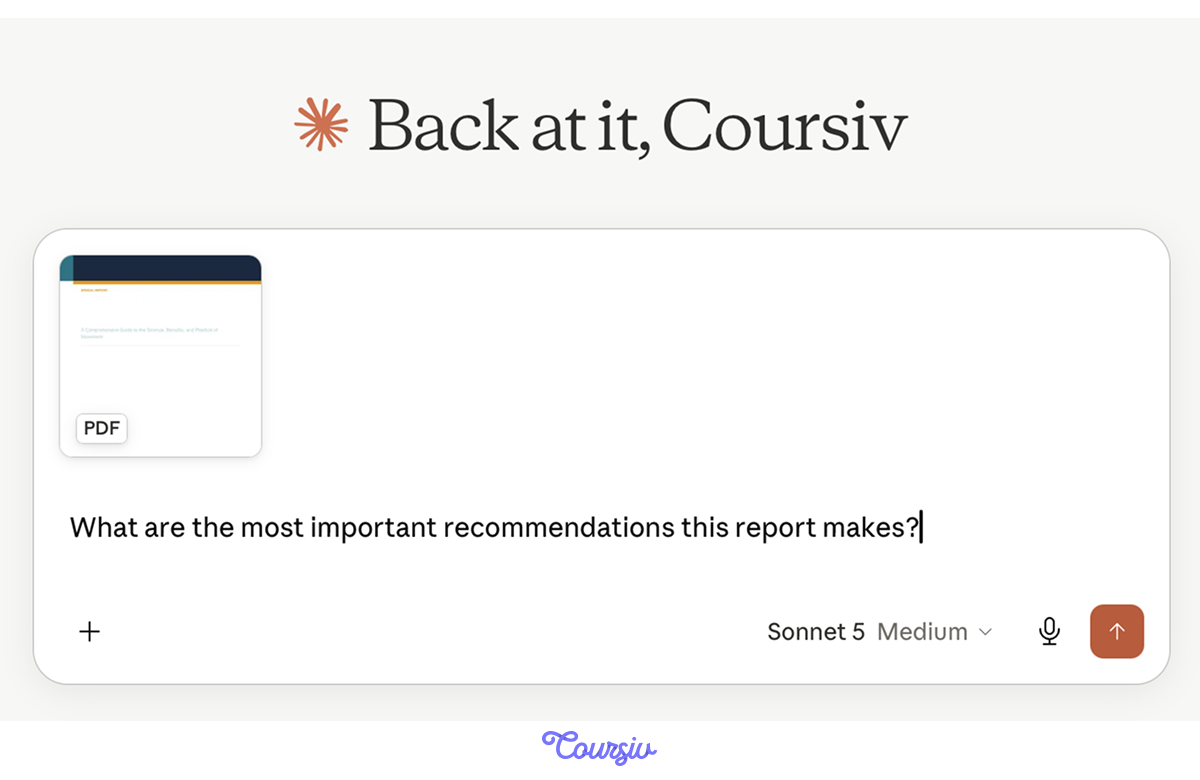
Imagine your friend sends a 40-page report on workplace wellness programs. You need to understand what it recommends, but you don't have time to read all of it.

You upload it to Claude and ask:
"What are the most important recommendations this report makes?"
Claude responds:
"- Wellness programs fail when they're optional add-ons. The report argues they should be integrated into normal work structure — not separate 'wellness activities.'
- Mental health support needs to be proactive, not reactive. Waiting for people to ask for help means they've already been struggling too long.
- Leadership participation matters more than program budget. Programs with engaged leadership and modest budgets outperform expensive programs with disengaged leadership."
In this response, Claude went beyond the executive summary and picked out the key ideas from the entire report.
Choose one
What makes this more useful than reading the executive summary?
You follow up:
"What trade-offs does this report acknowledge, and what does it not address?"
Claude responds:
"Acknowledged: Time investment vs. immediate productivity. Not addressed: How to implement this in remote or hybrid teams — the entire report assumes in-person work."
That's analysis: seeing what's there and what's missing.
Choose one
Why do you think noticing missing considerations is valuable?
Choose one
Claude summarized the report's takeaway as: "Leadership engagement matters more than budget — so any organization can run an effective wellness program, regardless of its size or setup." Reading critically, which part isn't actually supported by the report?
Finding Unexpected Connections
The hardest kind of synthesis happens when sources don't obviously relate.
Think back to the fatigue problem. You’ve got your health articles, but you also remember reading something about productivity systems and decision fatigue.
Could these ideas be connected?

practice preview
Interactive practice
Fill in the blank
See how you can ask Claude to find connections you wouldn't see on your own.
As you could see from the answer, Claude went beyond summarizing and highlighted the link between the ideas in your situation.
This is synthesis: seeing patterns that only emerge when you consider multiple ideas simultaneously.
What You Just Learned
In this lesson, you've learned to use Claude for sense-making.
When you have plenty of information but need understanding, its ability to hold many sources at once and reason carefully across all of them — without losing the thread — is exactly what the job needs.
In a nutshell, Claude can:
- Find patterns across sources
- Explain through teaching
- Identify what's present and what's missing
- And connect ideas that don't naturally relate
With this in mind, next, you'll see how Claude helps you pressure-test decisions and think strategically. Keep it up!