Claude · Prompting for Claude
Creativity Stimulation
Unleash Claude's creative thinking power
Claude's Creative Potential
In Unit 1, you learned what Claude is and the spaces you build in. Now we shift to something more powerful: how you ask.
Today we explore techniques that encourage more creative and innovative responses from Claude — and the surprise is that the right frame doesn't limit Claude's imagination, it directs it.
By the end of this lesson, you'll be able to craft prompts that inspire Claude to generate original, imaginative, and unconventional ideas.

Creative prompting means using specific techniques to encourage Claude to generate more original, imaginative, and unconventional responses.
Counterintuitively, creativity in Claude often comes from limits — a clear frame is what gives imagination something to push against.
Frame 1: Constraints
The clearest way to see this is with constraints. It sounds backwards — shouldn't limits kill creativity?
But when you cap the budget, the time, the format, or the audience, you push Claude off the obvious path and force it to invent.
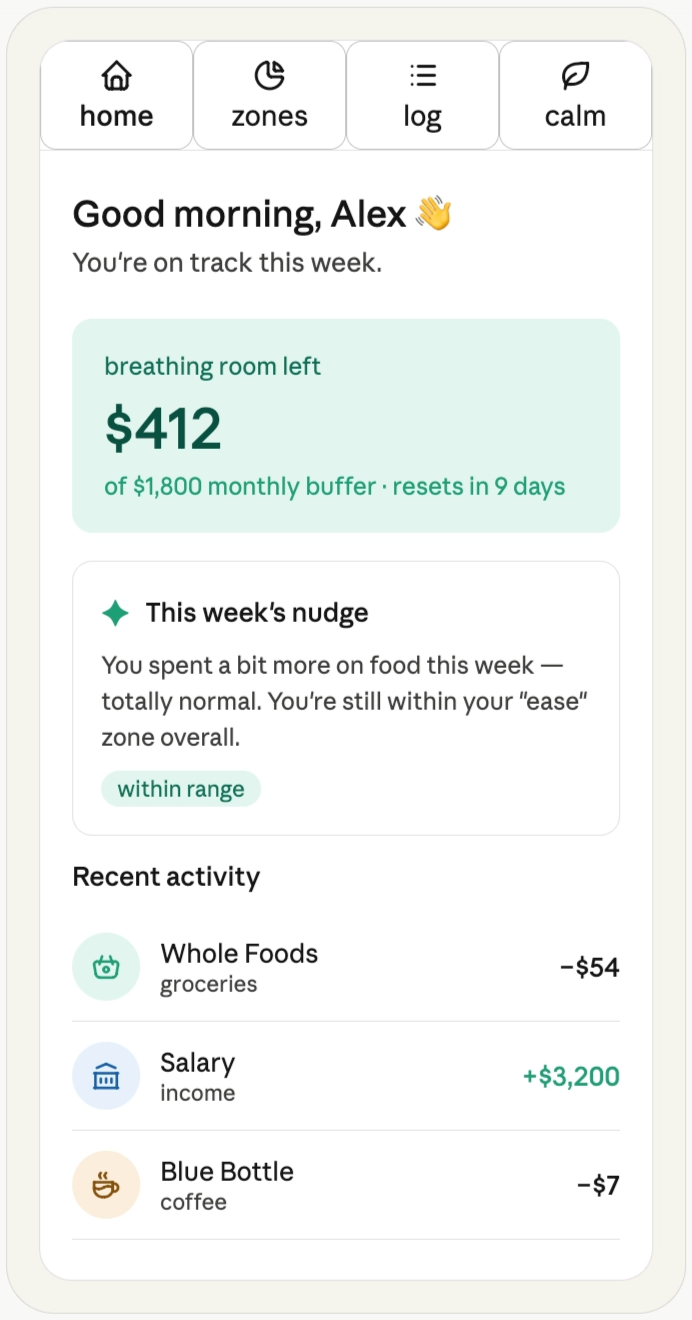
Suppose you're brainstorming an app with Artifacts that helps with budgeting. A simple "Design a budgeting app for people who find money stressful" prompt gave you this. Let's see how to get more interesting solutions from Claude here.
practice preview
Interactive practice
Fill in the blank
Turn a simple request into a creative one by adding limits. Fill each gap with a constraint that forces fresh thinking.
Imposing Arbitrary Constraints
By imposing arbitrary constraints — like limiting resources or time — you force Claude to think creatively within strict boundaries. This can lead to more inventive solutions, as constraints often inspire out-of-the-box problem-solving.
practice preview
Interactive practice
Fill in the blank
Сreate a prompt that imposes arbitrary constraints to inspire creative problem-solving.
By limiting Claude, you push it to think creatively, finding unique solutions under these constraints.
If you ask "give me ideas for a coffee shop" — you get generic and random instead of useful. Add one twist: "design a coffee shop for people who hate coffee." Suddenly Claude has to invent — tea flights, a dessert-and-conversation bar. Same topic; one frame that forces originality.
Frame 2: Posing Unusual Situations
Constraints are just one kind of creative frame. You can inspire Claude another way: pose an impossible or unusual situation, and Claude has to reason its way through it.
"What if" questions and strange hypotheticals give imagination a runway — a frame built from a premise that doesn't exist yet.

practice preview
Interactive practice
Fill in the blank
Complete the prompt that encourages creative thinking.
Great! This technique sets up an unusual scenario and prompts Claude to think creatively.
Bringing up something unexpected always makes Claude move past conventional responses.
Frame 3: Combining Unrelated Concepts
Mix two ideas from different worlds, and Claude builds something neither would produce alone. Describe an everyday object as something it's not, and a new function emerges from the collision.

practice preview
Interactive practice
Fill in the blank
Now, fill in the gaps to create a prompt using one of these techniques.
See how that worked? Fusing a smartphone with a living being pushed Claude toward functions a plain "improve my phone" prompt never would — healing, adapting, sensing. Two inputs, one new thing.

Frame 4: Reversing Assumptions
This technique also challenges conventional ideas or expectations. But instead of fusing two ideas into something new, you take a single assumption everyone accepts — and flip it.
"What if a library were loud?" "What if customers paid less the more they bought?" Inverting one default forces fresh thinking from a single idea, not two.
Select all that apply
Which benefits can you achieve with the "reversing assumptions" technique?
Frame 5: Metaphorical Thinking
Now that you understand how reversing assumptions works, let's explore how metaphorical thinking can encourage abstract creativity.
By comparing an idea to something seemingly unrelated, you help Claude explore new connections and generate unique responses.
practice preview
Interactive practice
Fill in the blank
Encourage Claude's abstract thinking by completing a metaphorical prompt.
Great work! By comparing a car to a flowing river, Claude can explore how this metaphor shifts the function of the object, sparking abstract, creative responses.
Frame 6: Multiple Perspectives
Encouraging Claude to consider ideas from various viewpoints opens up a broader range of responses.
Ask Claude to answer as several different people — a designer, a skeptic, a customer — and you get a rounder, less obvious set of ideas. Each viewpoint is its own small frame, and stacking them widens the field.
practice preview
Interactive practice
Fill in the blank
Fill in the gaps to ask for multiple perspectives to solve a problem creatively.
Don't Just Generate — Judge
Producing an idea is only half the skill; the other half is knowing if it's any good.
Before you accept a creative output, run it past three quick tests: is it specific (not vague), surprising (not the obvious answer), and useful (does it fit your goal)? If it flunks one, adjust the frame and run it again.
Choose one
You have two options from Claude for the same idea — "design a fitness app for people who hate exercise." Which one actually uses the constraint more effectively to get creative?
Well Done!
You've learned multiple techniques to encourage more creative, original responses from Claude — from unusual scenarios to constraints and perspective shifts.
These approaches help move beyond obvious ideas and explore unexpected possibilities. Each one aims Claude's imagination somewhere specific, and the judging tests tell you when it landed.
Select all that apply
Last task! Which creativity techniques work best for generating innovative product ideas?
What's Next?
Next, you'll meet a different kind of frame — analytical frameworks like SWOT and Porter's Five Forces. Where creative frames open possibilities up, these structure them into focused, rigorous analysis.
It's the same core skill you just practiced — handing Claude a lens — pointed at a sharper goal.