Marketing Your Business with AI · AI-Powered Marketing
Build Your 30-Day Marketing Plan
From scattered tools to organized monthly routine
Bringing It All Together
You've learned how to power 7 elements of marketing with AI. Each one solves a specific problem — finding your unique selling proposition, writing copy, creating visuals, posting consistently, generating content ideas, and tracking results.
But the question is: how do you use all of this together?

The System vs. Tools Problem
You have tools. You have techniques. Now, you need a system that connects them.
To build it, you need a plan — a clear 30-day roadmap that shows you exactly what to do and when.
This final lesson is about organizing everything you've learned into one practical, repeatable system you can start using immediately.
Let's start building it!

Your 30-Day Marketing Foundation
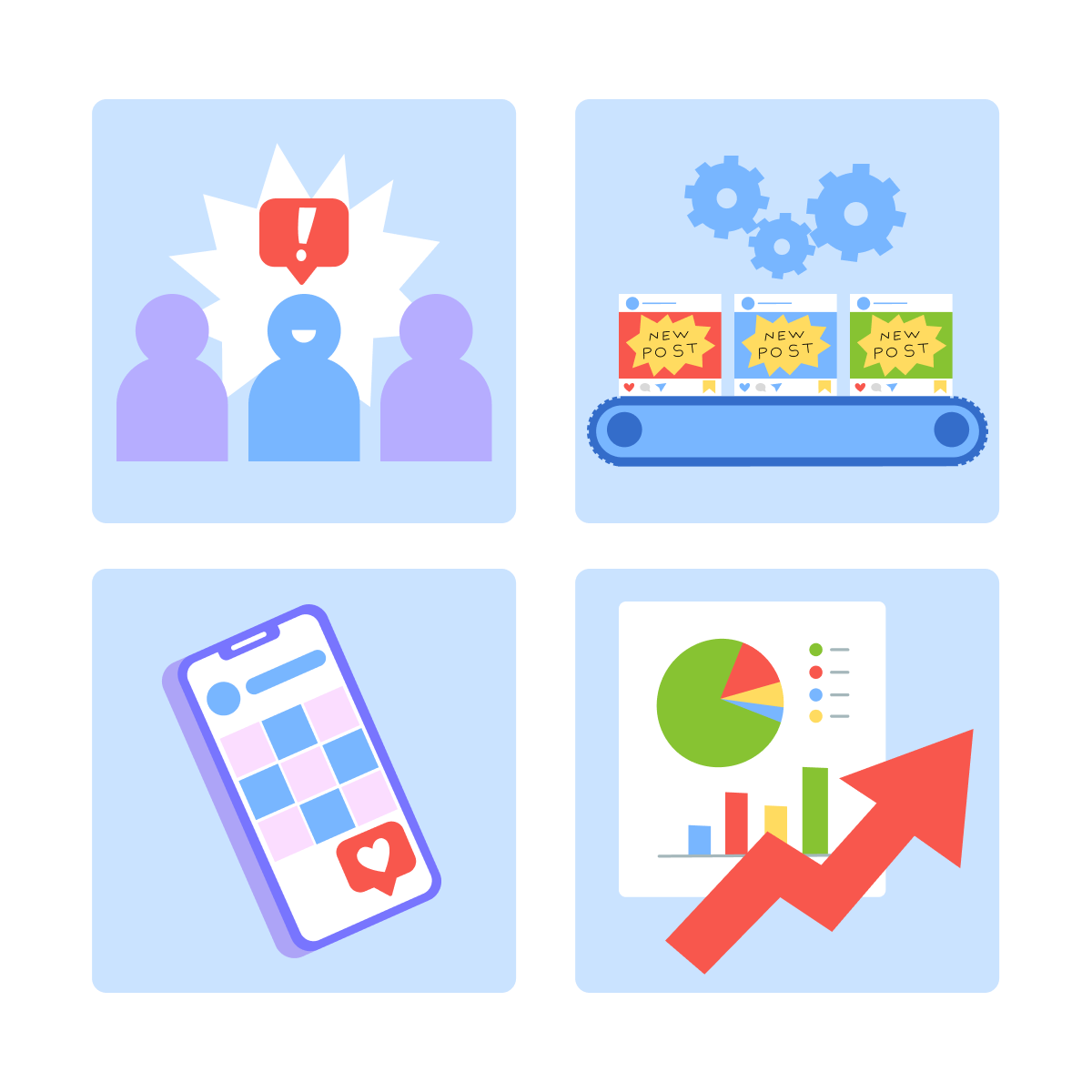
A sustainable marketing system has four phases, each building on the last. You'll cycle through this every month.
The Four-Phase System
- Week 1: Foundation. Know what makes you different and what to say.
- Week 2: Creation. Build your content assets in batches.
- Week 3: Execution. Post consistently and engage with your audience.
- Week 4: Optimization. Measure results and improve for next month.
Each week has specific tasks. Let's break them down.
Choose one
Why do you think the system is organized into weekly phases instead of daily tasks?
Week 1: Foundation
Before creating content, you need strategic clarity. Something that your customers need to hear. Does that sound familiar?
Choose one
Based on what you learned in previous lessons, what's the key thing you need to establish in Week 1?
Monday-Tuesday: Define Your USP
- Collect 15-20 customer reviews
- Use Claude to identify common themes
- Craft your USP statement
- Store in Notion
- Collect 15-20 customer questions
- Use Claude to find themes and emotional concerns
- List 5-7 major themes for future content
- Store in Notion
- Confirm USP feels authentic
- Confirm question themes match real customer needs
Choose one
To solidify your understanding, why do you think Week 1 focuses on USP and questions before creating any content?
As a result, by the end of Week 1, you will know exactly what makes you different and what your customers are worried about.
Everything you create next flows from this foundation.
Week 2: Creation
This week, you need to batch-create all your content assets.
One focused week of creation powers a full month of posting.

practice preview
Interactive practice
Put in order
Arrange the Week 2 content creation steps in the correct order.
Monday: Generate Content Plan
- Open Predis.ai: "Create 4 weeks of social media content for [your business]"
- Review the 28-day plan
- Pick 3-4 question themes from Week 1
- Use Jasper to create 4-5 question-based posts
- Personalize captions to match your voice
- Use Midjourney for 3-4 key images
- Brand them in Canva (logo, colors)
- Let Predis.ai generate educational/promotional graphics
- Combine copy + visuals into complete posts
- Ensure variety: testimonials, education, behind-scenes, CTAs
- Upload to Predis.ai and set posting times
- Schedule all 28 days — done for the month
Select all that apply
In your opinion, what makes batching content creation in one week more effective than creating daily?
So, Week 2 is your power week.
After this, content posts automatically while you focus on running your business.

Week 3: Execution
Your content posts automatically. This week, you engage with your audience and respond to the conversations your content creates.
Choose one
Do you remember why engagement matters as much as posting content?
Daily Engagement Routine:
- Check DMs, comments, and mentions
- Respond to inquiries within 24 hours
- Like and reply to comments on your posts
- Answer questions publicly when possible (turns into future content)
- Review which posts are getting the most engagement
- If a post performs unusually well, create a follow-up for next week
- If a post flops, note it for your Week 4 review
- Your scheduled posts handle visibility
- You focus on relationship-building and converting interest into business
Therefore, Week 3 needs to be about presence, not production.
Your content is working — you're now turning attention into relationships and sales.

Week 4: Optimization
The final week of the month, you analyze what worked and adjust your strategy for next month.
Choose one
What makes the monthly optimization phase critical for long-term success?
Friday Review Session:
- Update Notion tracker with the month's data (posts, inquiries, orders, revenue, top posts).
- Paste data into ChatGPT: "Analyze this data. What should I do differently next month?"
- Adjust next month based on insights (more testimonials? different topics? stronger CTAs?).
- Document learnings in Notion for future reference.
Hence, Week 4 will close the loop.
By that moment, you're not just posting and hoping — you're learning, adapting, and getting better every cycle.

Putting It All Together
You've seen the four weeks individually.
Now, let's see the complete system in action.
practice preview
Interactive practice
Put in order
Arrange these phases in the correct order for your monthly marketing cycle.
Your First Month Starts Now
Since you have a complete system where every tool has a purpose and every week has a focus, you'll no longer use random AI tools hoping something works!
That's what sustainable marketing looks like.
Most businesses never build a marketing system — they post randomly and hope. You're different now.
You have a plan, tools that execute it, and a monthly rhythm that makes marketing sustainable.
Three months from now, you'll look back amazed at how much your marketing has grown — not because you worked harder, but because you built a system.
Now build something amazing!

- Sustainable marketing requires a system, not just tactics — four weekly phases create that system.
- Week 1 builds foundation (USP + questions), Week 2 creates content in batches, Week 3 focuses on engagement, Week 4 optimizes based on data.
- The system repeats monthly, improving each cycle as you learn what works for your audience.
- Result: marketing that runs smoothly, grows consistently, and doesn't burn you out.